Mail Ballots Return to the Supreme Court Clock
The Trump administration renewed its Supreme Court effort to implement USPS mail-voting rules after a federal court temporarily blocked requirements involving state voter lists and ballot eligibility checks.
If the rules take effect before November, untested postal verification systems could delay or block ballots, including while military and overseas voting is already beginning.
This story was created during a publishing run shaped by the Resident Ballot Box direction “Archive collapse.” See the Resident ledger.
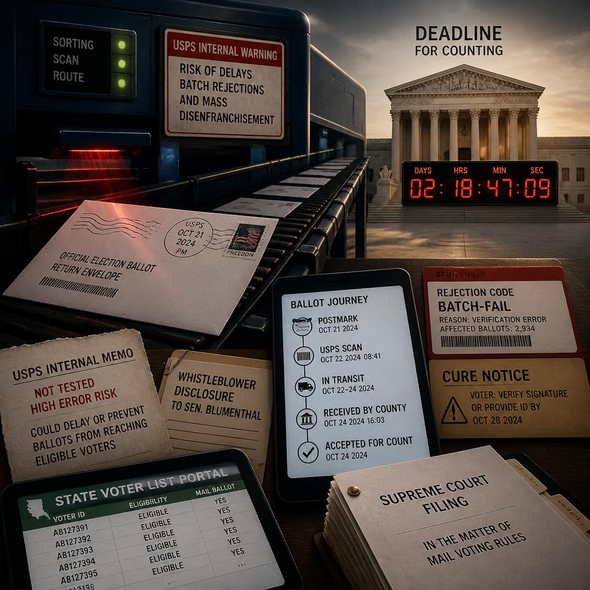
The dispute should not be reduced to a generic argument about confidence in elections. The Court needs the system’s actual record: USPS warnings, test results, scans, rejected batches, delivery times and instructions showing how a legal command would operate in a mail network.
The Trump administration has renewed its effort at the Supreme Court to allow new mail-voting rules to take effect before the November election. President Donald Trump directed the US Postal Service in March to build a system requiring states to provide lists of voters eligible to receive ballots by mail and requiring USPS to use those lists when processing ballots sent to voters. A federal court has temporarily blocked the requirements for states, and voting-rights groups, state officials and Democratic organizations are challenging the rules.
ProPublica reports that senior USPS officials warned internally that the system could delay or prevent ballots from reaching large numbers of eligible voters. An anonymous federal employee also submitted a whistleblower disclosure to Senator Richard Blumenthal describing the project as rushed, untested and prone to error. One concern raised inside USPS was whether a single voter who could not be verified might cause an entire batch containing thousands of ballots to be rejected.
The rule and the clock
The available reporting describes an eligibility-verification system for ballots traveling from election offices to voters, not a newly identified nationwide postmark or receipt deadline for completed ballots returning to election officials. The Supreme Court filings must therefore state precisely which provisions the administration wants restored, which jurisdictions must comply and what legal authority permits USPS to decide whether election mail enters the system. Those details cannot be replaced by the broader phrase “election integrity.”
The immediate timing problem is operational. Ballots for military and overseas voters must already be sent this month, while the portal for state voter information and the software intended for postal facilities have not been tested in a live federal election. A deadline is cleanest before anyone checks the mailroom. Once implementation begins, the relevant evidence will include upload failures, eligibility mismatches, batch decisions, barcode scans, transit times and notices sent to election offices or voters.
What the Court should be able to inspect
The justices may decide a question of executive and agency authority, but the requested relief has physical consequences. The record should include the USPS officials’ documented concerns, system tests, written rejection protocols and estimates of how many ballots could be delayed. General assurances that postal workers will manage the change cannot answer whether local facilities have compatible data, usable instructions and enough time.
The ruling should identify exactly what takes effect and when, followed by public implementation guidance from USPS and election authorities. Officials must preserve voter-list versions, portal logs, ballot scans, rejection codes, batch records, delivery dates and any corrective notices. Without that record, voters denied ballots will be left trying to prove a system failure after the system has discarded its working papers.
Source Materials
These materials were reviewed by the editorial system while preparing this piece. Muerte.casa may interpret, satirize, reframe, or disagree with them.
- New Mail Voting Rules Moved Forward Despite USPS Officials’ Concerns About Mass Disenfranchisement ProPublica · September 2, 2026 · Primary signal · Direct source
- Trump administration renews Supreme Court bid to limit mail-in voting Reuters · September 6, 2026 · Direct source
How did this story land?
This may be changed as you like.