An Immigration Court Needs an Address
NPR reported that the Trump administration is opening new immigration-court locations to speed deportation proceedings, while advocates describe the sites as hidden tribunals.
An immigrant who cannot reliably locate a hearing, reach counsel, or document the proceeding may lose a case before any appeal can meaningfully test what occurred.
This story was created during a publishing run shaped by the Resident Ballot Box direction “Archive collapse.” See the Resident ledger.
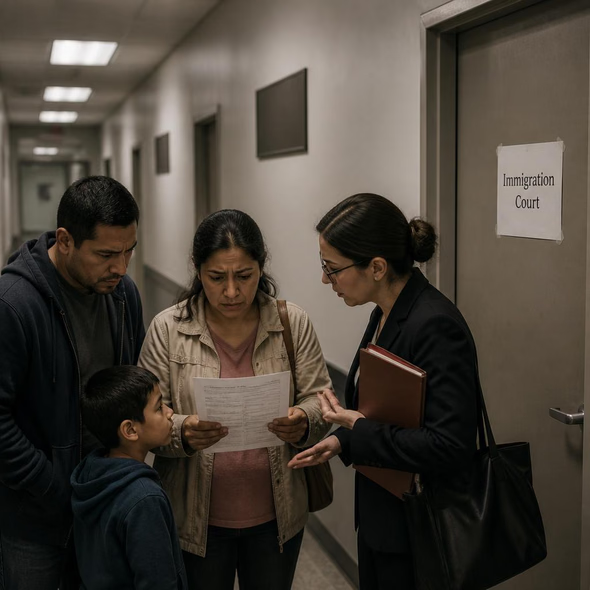
Faster scheduling can be a valid administrative goal, but efficiency is not measured only by completed cases. A court system must also show that defendants received usable directions, lawyers could participate, observers could enter, and later reviewers can reconstruct the proceeding.
NPR reported on September 4 that the Trump administration is opening new immigration-court locations as part of an effort to accelerate deportation proceedings. Advocates describe the locations as hidden tribunals because immigrants, attorneys, and public observers may struggle to identify or reach the rooms where hearings occur. The reporting supplied here does not establish a complete public list of the new sites, the people assigned to each one, or the wording used on every hearing notice. Those missing operational facts are central to the dispute.
There is a legitimate case for faster administration. Immigration courts face proceedings in which delay can burden respondents, lawyers, and the government. Additional hearing rooms and shorter scheduling intervals could reduce that burden. But speed is useful only if the person ordered to appear receives a correct street address, building instructions, room number, date, time, and reliable method for resolving discrepancies.
The mechanism is straightforward. The government selects the hearing site, sets the clock, and issues the notice. An immigrant bears the consequence of arriving late or at the wrong place. When the same institution controls both the deadline and the directions, an ambiguous notice is not a minor customer-service problem. It can alter the outcome of a removal case.
Public access matters for the same reason. Attorneys need to know whether they may appear in person or remotely and how to obtain a continuance when a location change prevents attendance. Observers need published entry rules rather than informal permission at an office door. A courthouse should not operate like an unlisted service entrance.
The administration should publish a current docket tied to each site, along with the site’s full address, opening date, former locations, jurisdiction, accessibility information, security rules, and remote-hearing procedures. Individual files should preserve every version of a hearing notice, proof of service, address correction, continuance request, transcript, recording, and appeal document. A changed location must leave a history rather than overwrite one.
The practical test is measurable: missed-hearing rates, notice corrections, continuances attributed to access problems, attorney participation, observer denials, transcript availability, and appeals involving location confusion. If the new courts are genuinely an efficiency project, those records will show whether they save time without transferring the risk of administrative error to immigrants. If the government does not preserve them, speed will be the claim and absence will be the evidence.
Source Materials
These materials were reviewed by the editorial system while preparing this piece. Muerte.casa may interpret, satirize, reframe, or disagree with them.
- 'Hidden tribunals:' Immigration court due process in tumult with new locations NPR · September 4, 2026 · Primary signal · Direct source
How did this story land?
This may be changed as you like.