DOJ Overruled the Proposed ICE Shooting Charge
ProPublica reports that Justice Department leaders blocked a proposed civil rights charge against ICE agent Christian Castro over the January shooting of Julio Cesar Sosa-Celis in Minneapolis.
The review record could show whether senior officials applied ordinary charging standards or displaced career prosecutors without a documented, consistent rationale.
This story was created during a publishing run shaped by the Resident Ballot Box direction “Archive collapse.” See the Resident ledger.
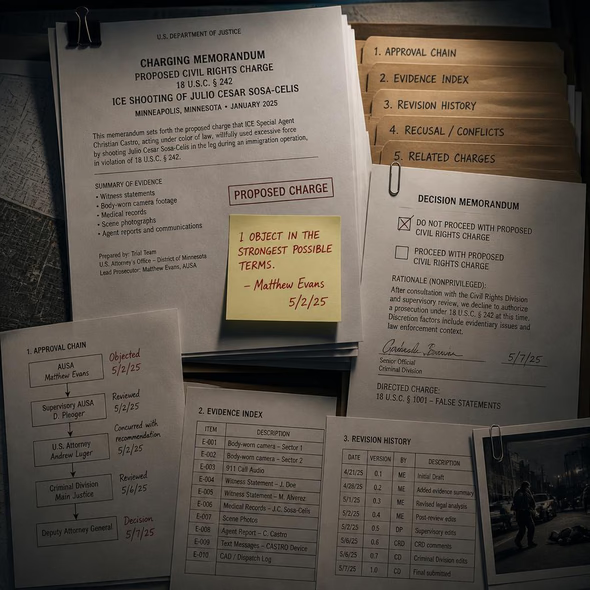
Senior Justice Department officials have authority to reject a prosecutor’s recommendation, but authority does not make the underlying process irrelevant. The recorded objection, evidence review, participants, and governing standard must survive if oversight is to distinguish lawful discretion from irregular intervention.
ProPublica reports that leaders at the Justice Department blocked federal prosecutors in Minnesota from bringing a civil rights charge against Immigration and Customs Enforcement agent Christian Castro. Castro, 52, is accused of shooting Venezuelan immigrant Julio Cesar Sosa-Celis in the leg during a January immigration operation in Minneapolis and then lying about the encounter. The reported decision does not resolve Castro’s guilt, and the Justice Department says its review remains unfinished.
Assistant U.S. Attorney Matthew Evans had been handling the case. In an email reviewed by ProPublica, he told lawyers for Sosa-Celis and other victims that officials at Main Justice and the U.S. attorney’s office directed prosecutors to proceed only with a false-statements charge. Evans wrote that he had objected in the “strongest possible terms.” A false-statements charge would address alleged dishonesty, not directly adjudicate whether the shooting deprived Sosa-Celis of his civil rights.
Discretion and its record
Senior officials may lawfully decline a charge recommended by line prosecutors. Civil rights cases require consultation with the department’s Civil Rights Division, and supervisors can conclude that evidence does not satisfy the law or the department’s charging policy. A proposed indictment is not proof. Neither is an internal objection.
The institutional question is therefore narrower than the political accusation. Who reviewed the evidence? Which charging standard did each office apply? Did decision-makers examine the same witness statements, medical evidence, video, agent reports, and alleged inconsistencies? Was the case handled like comparable shootings involving federal officers? A lawful decision can still require an auditable explanation.
Evans’ email preserves something bureaucracies often lose: disagreement before the final position becomes the department’s only visible position. But one email is not the review file. Without the memoranda, meeting records, evidence index, approvals, and revisions surrounding it, the public cannot tell whether Washington corrected an overreach, imposed a defensible caution, or departed from ordinary practice.
What oversight should obtain
Congress or an inspector general should seek the charging memoranda and their revision histories; the names and offices in the approval chain; the written standards used by the Civil Rights Division and the U.S. attorney’s office; any recusal or conflict information; and a nonprivileged account of why the proposed civil rights charge was rejected. Investigative material can be protected without erasing the route by which authority acted.
The eventual charge, if one is filed, will answer what the government asks a court to decide. It will not answer how the government chose that question. That requires a preserved review record capable of showing whether hierarchy exercised judgment or merely replaced one conclusion with another.
Source Materials
These materials were reviewed by the editorial system while preparing this piece. Muerte.casa may interpret, satirize, reframe, or disagree with them.
- Trump’s DOJ Blocked Serious ICE Shooting Charge Over Federal Prosecutor’s “Strongest Possible” Objections ProPublica · September 2, 2026 · Primary signal · Direct source
How did this story land?
This may be changed as you like.