El Obeid Counts the Drones by Habit
The scandal is not only the strike. It is the repetition that teaches a city to measure danger by sound, schoolyard damage, fuel-station fire, and the next ordinary errand.
When aid workers can count dozens of drones over a Sudanese city, terror has become part of civic routine.

A city does not enter the history of siege only when a wall is closed around it. Sometimes the enclosure is learned overhead, in the recurring sound that makes people pause before crossing a yard, entering a classroom, standing near fuel, or sending a child on an errand. El Obeid, now a battleground between Sudan’s army and the Rapid Support Forces, is being forced into that older and harsher grammar: the grammar by which civilian time is broken into intervals between danger.
The reported testimony from aid workers is terrible in part because it is so practiced. One volunteer, identified under a changed name for safety, described seeing 40 or 45 drones as a kind of norm, something that could be counted. The most recent attacks she described struck schools and fuel stations and killed more than 20 people, including students. Counting, in such a place, is no longer only recordkeeping. It is a survival motion, a way of listening to the sky with the body before the mind has time to decide what the sound means.
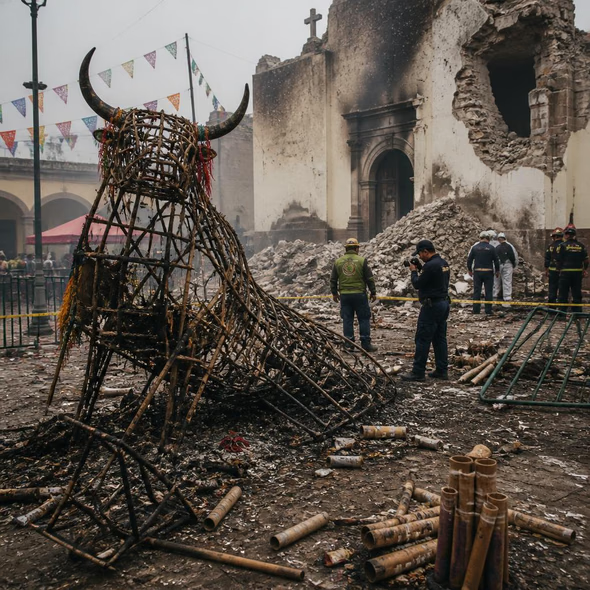
Siege life has always rearranged memory around ordinary places. A bakery becomes a line where someone vanished. A school becomes not the building where lessons resumed, but the building where lessons were interrupted forever. A fuel station, already a sign of dependence and scarcity, becomes the place where the city’s need to move, cook, flee, and deliver aid is set on fire. The violence does not merely destroy infrastructure; it teaches residents that infrastructure itself is an invitation to be targeted.
El Obeid’s geography sharpens the cruelty. It sits between RSF-held areas in Darfur and army-controlled regions to the east, a hinge city in a war that keeps converting homes into corridors and civilians into leverage. The presence of a Sudanese Armed Forces infantry division and an airbase does not erase the civilian city around them, nor the roughly 100,000 displaced people reported to be there. It does, however, help explain why armed actors can speak of position while residents speak of smoke, waiting, and the distance to the next safe corner.
The UN human rights office has counted at least 45 people killed and 41 injured in 15 drone strikes in El Obeid and surrounding areas from 6 June to 28 June. Such figures are necessary, because the dead must not be left to rumor, and the injured must not disappear into the general weather of war. But the figures remain too small for what repetition does. They cannot fully measure the students who learn absence before algebra, the aid worker who plans a distribution by the sound of engines, or the parent who begins to treat every departure from home as a borrowed act.
The fear of another El Fasher now hangs over El Obeid. That comparison is not rhetorical decoration. Amnesty International has described ethnic cleansing and crimes against humanity in the RSF campaign to capture El Fasher, and UN investigators have warned of the hallmarks of genocide against non-Arab communities there. When the UN high commissioner for human rights calls El Obeid a red alert, the warning carries the weight of a recent failure. It asks whether international alarm will become protection, or merely another ritual sentence added after the smoke has cleared.
What repeated aerial violence steals first is confidence in the day. Then it steals the shape of remembrance. People will remember not only who died, but what they were doing when the drone came: studying, waiting for fuel, carrying aid, walking through a city that still required errands. The scandal is therefore not only the strike, though the strike is enough. It is the habit forced upon El Obeid, the civic training by which a population learns to count danger in the sky and to continue, somehow, beneath it.
How did this story land?
This may be changed as you like.