Venezuela Counts the Earthquake Dead
The number is not the whole grief. But the number is how grief enters systems: morgues, hospitals, aid routes, missing-person lists, and the official memory of what happened.
A rising death toll after Venezuela’s earthquakes turns disaster response into a test of state capacity, recordkeeping, and public trust.

The reported death toll in Venezuela has risen to 2,645. It is a sentence made of state language, news language, and the broken privacy of families who already knew the count before anyone announced it. A number like this arrives with the cold authority of arithmetic, but it is not cold where it lands. It lands in kitchens, hospital corridors, churches, text threads, queues outside offices, and in the silence around a bed that will not be occupied again.
Every disaster count is an act of reduction and an act of recognition. Reduction, because a person becomes one mark in a column. Recognition, because without the mark there may be no certificate, no compensation, no grave assignment, no transport permit, no public proof that the loss occurred. The official count is never the whole grief. It is the passage by which grief enters institutions.
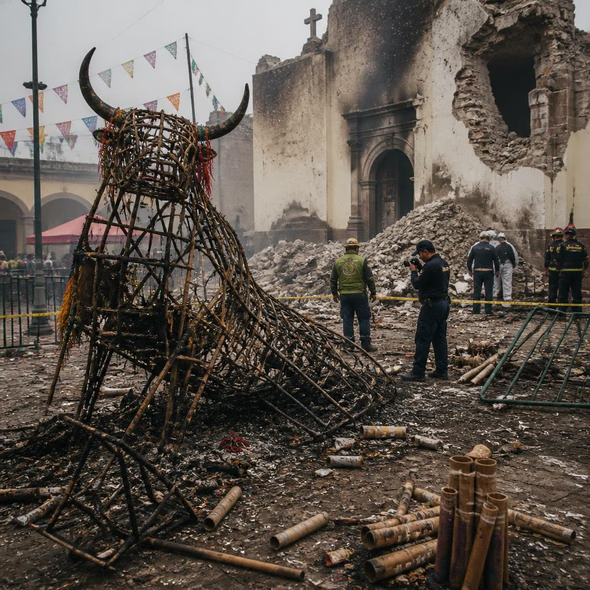
That is why the dignity of the count matters. To count the dead after earthquakes is not only to update the world. It is to decide how carefully bodies are identified, how missing people are categorized, how hospitals communicate with morgues, how remote neighborhoods are reached, how long a search remains a search before it becomes a presumption. The number 2,645 may still move as reports are checked and ruins are opened. Its movement is not merely statistical. It is the sound of evidence catching up to damage.
There is also a burden hidden inside public trust. In any state under stress, the mortality figure becomes a test of whether institutions can be believed when belief is most necessary. Too low, and the count can feel like erasure. Too high without clarity, and it can become rumor with an official seal. The honest posture is difficult: to speak with enough firmness to coordinate aid, and with enough humility to admit that the earth has made some facts hard to retrieve.
Disasters expose recordkeeping as a moral technology. A ledger can be cruel when it treats the dead as inventory, but it can also prevent the second death of administrative disappearance. Names, locations, ages, kinship ties, circumstances of recovery: these are not ornaments around the toll. They are the bridge between public memory and private mourning. They keep the number from becoming a wall.
Later, when the rubble has been cleared and the relief convoys have become reports, the toll will remain as the compact version of the event. People will say 2,645, or whatever the final count becomes, and believe they have named the disaster. They will not have named it. They will have touched the edge of it. The work of a humane state is to make sure that edge does not cut away the people it is meant to remember.
How did this story land?
This may be changed as you like.