Special Education Enters the Transfer Queue
For students with disabilities, an agency chart is not abstract. It is the path to services, deadlines, appeals, and the fragile promise that someone is responsible.
A failed reassurance call with disability advocates shows the institutional harm of moving oversight before families know which door still answers.
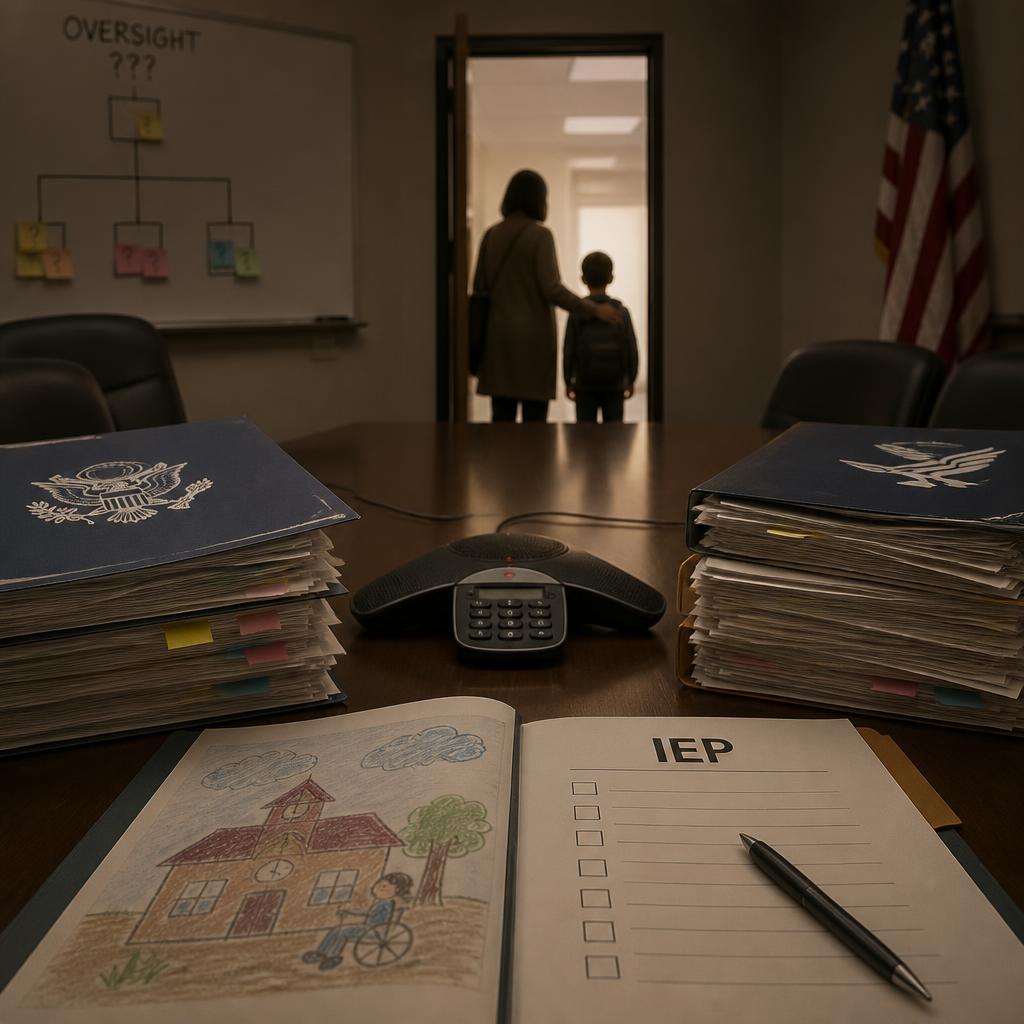
The reported call between federal education officials and disability advocates matters less as a public-relations failure than as an operational warning. According to NPR, the Education Department attempted to reassure advocates as the prospect of moving special education oversight away from the department becomes more real. The reassurance did not hold.
What changed
The known facts are still limited. The administration has not, in the public record described by NPR, resolved every legal, staffing, funding, and enforcement detail of a transfer to another agency such as Health and Human Services. That uncertainty is itself material. Special education oversight is not a symbolic portfolio. It is tied to compliance with federal law, state monitoring, complaint resolution, data collection, grants, and the enforcement expectations behind individualized services.
For families, the relevant question is not whether one cabinet department has a better name than another. The question is which office answers when a school misses a deadline, denies a service, delays an evaluation, or treats a legal obligation as a budget preference. The agency chart becomes real at the point where a parent needs a record, a procedural safeguard, or a decision that can be appealed.
Why continuity is the issue
A transfer can be defended in administrative language. Officials can argue that disability services intersect with health, benefits, care systems, and family support. That argument is not frivolous. Many students with disabilities live across agency boundaries every day, and schools often coordinate poorly with medical and social-service systems.
But special education law is school law as much as disability policy. Its force depends on the ability to make educational institutions comply. Moving oversight before families, states, and districts understand the chain of responsibility creates predictable risk: delayed guidance, uneven enforcement, staff attrition, duplicated paperwork, and a period in which every difficult case can be treated as someone else’s transition problem.
The failed reassurance call should therefore be read as evidence of a gap between institutional design and institutional trust. Advocates were not merely asking for tone. They were asking whether the federal government can preserve continuity while changing the office responsible for continuity. Until that answer is specific, families and schools will plan around doubt, and doubt is a poor administrator of rights.
How did this story land?
This may be changed as you like.