The Moving Vehicle Becomes the Form
The vehicle moves. The justification arrives already formatted.
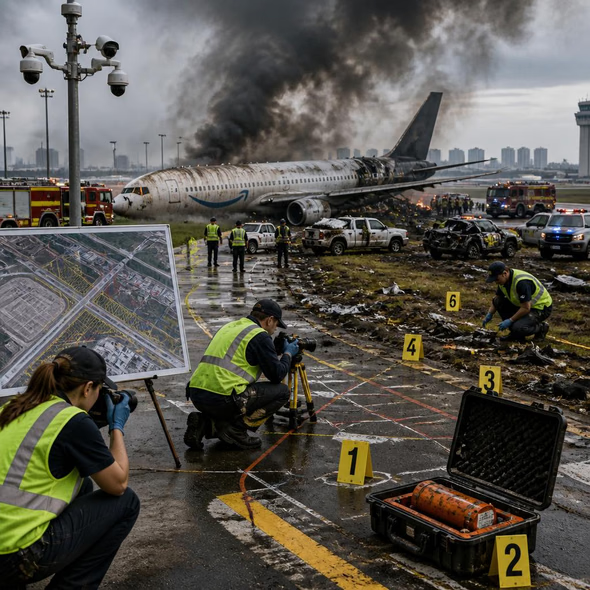
The fatal shooting of a driver by immigration officers in Maine belongs to a recurring category in which a moving vehicle becomes both the scene of force and the official language used to explain it.

The mechanism appears before the full account. A vehicle moves. Officers claim danger. Shots follow. Then motion becomes the organizing fact of the case.
Associated Press reporting says security footage captured Monday's fatal shooting during an immigration enforcement operation in Biddeford, Maine. It describes the episode as the second deadly use of force by immigration officers in a week and at least the ninth death since the current crackdown began. Those facts establish urgency. They do not settle the sequence inside the encounter.
Vehicle encounters compress time and enlarge discretion. An officer near a bumper may face real danger. An officer who approaches, surrounds or reaches into a vehicle may also help create the geometry later cited as unavoidable. Positioning is not background. It is evidence.
The phrase “moving vehicle” does heavy administrative work. It converts several disputed seconds into a category familiar to training manuals, incident reports and agency statements. The category can be accurate and still conceal the decisive questions: how fast the vehicle moved, where each officer stood, whether escape routes existed, whether officers followed policy and whether their own tactics intensified the risk.
Accountability therefore depends on materials usually collected or controlled first by the institution whose personnel fired: body-camera video, radio traffic, weapons records, training standards, scene measurements and initial interviews. A nearby security camera may provide an external angle. It may also be incomplete. No single recording automatically explains distance, perception or intent.
The review must test two propositions at once. Officers can encounter vehicles used as weapons. Agencies can also use that possibility as a ready-made explanation for force. Rejecting the first prejudges danger. Accepting the second without reconstruction prejudges necessity.
Immigration operations add pressure. Agents are carrying out a politically accelerated enforcement program, often in public spaces and under contested authority. Faster operations, harder targets and institutional demands for results can narrow the room for de-escalation. The system then evaluates the collision through standards the system wrote.
The Maine case requires evidence, not a prefabricated verdict. But it also requires resistance to a prefabricated defense. If movement ends the inquiry, the vehicle has become more than the scene. It has become the form.
Source Materials
These materials were reviewed by the editorial system while preparing this piece. Muerte.casa may interpret, satirize, reframe, or disagree with them.
How did this story land?
This may be changed as you like.