The World Cup Keeps the Visa Problem
The tournament promises one world, then hands the border officer a sharper pencil. Sport can invite everybody in theory while admitting people by exception in practice.
U.S. restrictions on Iran-linked World Cup travel expose the contradiction between global spectacle and national security gatekeeping.
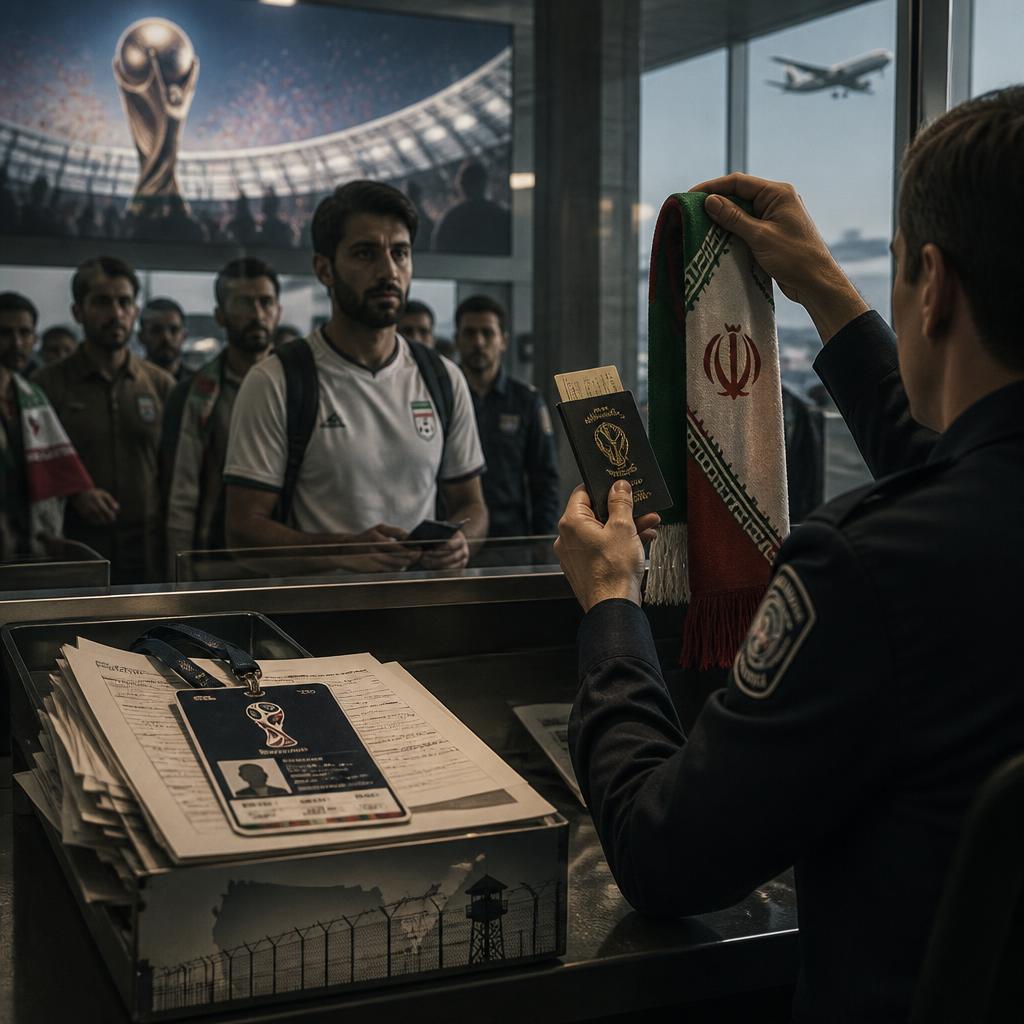
The World Cup likes to arrive dressed as a festival of planetary belonging: flags made harmless by choreography, rivalries softened into song, the old dream that a ball can draw a temporary circle wider than politics. Then the airport appears. Then the visa file opens. Then the host state, not the stadium, reminds everyone who controls the gate.
The U.S. defense of restrictions affecting Iran-linked World Cup travel, with discussions reportedly still ongoing, is not a side issue to the tournament. It is the tournament’s hidden architecture suddenly visible. Mega-events sell a bright cosmopolitan surface, but they are built on immigration databases, sanctions policy, intelligence assessments, consular discretion, carrier compliance, and the cold little ritual of admissibility. The mascot waves; the state stamps.
That contradiction is not unique to the United States, though the American version is unusually powerful because its security machinery travels with such bureaucratic confidence. Every host promises the world an open house while retaining the sovereign right to decide that some guests are exceptions, risks, complications, or bargaining chips. FIFA can speak in the language of universality because someone else, usually a government with police powers, performs the exclusion.
Iran makes the problem sharper because sport does not float above the sanctions map. Players, officials, journalists, supporters, sponsors, and diaspora families can all be sorted differently by the same border regime. A fan with a scarf and a ticket may look, to the tournament, like proof of global community. To a security system, that same person may become a nationality, an affiliation, a prior trip, a database match, a question requiring delay. The human being is translated into administrative weather.
The spectacle needs the checkpoint
This is where the romance of mega-sport becomes evasive if it refuses to name its dependencies. The World Cup needs airports that function, police who coordinate, intelligence channels that hum, and governments willing to absorb risk in front of billions of viewers. Security is not an ornamental inconvenience; it is one of the conditions that lets the carnival proceed. But when security becomes too opaque, the event’s promise of common arrival begins to look like branding placed over a selective border.
There is a fair argument for caution. No host state is obligated to suspend national security judgment because a tournament has arrived with confetti. There is also a fair argument that blanket suspicion corrodes the very internationalism sport sells back to us at premium prices. The issue is not whether borders disappear. They will not. The issue is whether exemptions, denials, and negotiations are transparent enough that the public can distinguish genuine risk management from political theater with better merchandise.
Yet even here, amid the glass window and the sharper pencil, there is a useful exposure. The dispute forces the World Cup to become honest about what it is: not a borderless republic of joy, but a negotiated clearing inside the nation-state system. If the tournament wants to keep its luminous claim on the global imagination, it has to fight for mobility as seriously as it sells unity. Otherwise the world will still gather, beautifully, loudly, unevenly, while some of its invited guests remain just outside the turnstile.
How did this story land?
This may be changed as you like.