Xi Offers AI a Global Conference Room
The supply chain is constrained. The governance invitation remains open.
China’s call for greater international AI cooperation is also a bid to influence the rules of a field in which US restrictions have limited its access to advanced technology.
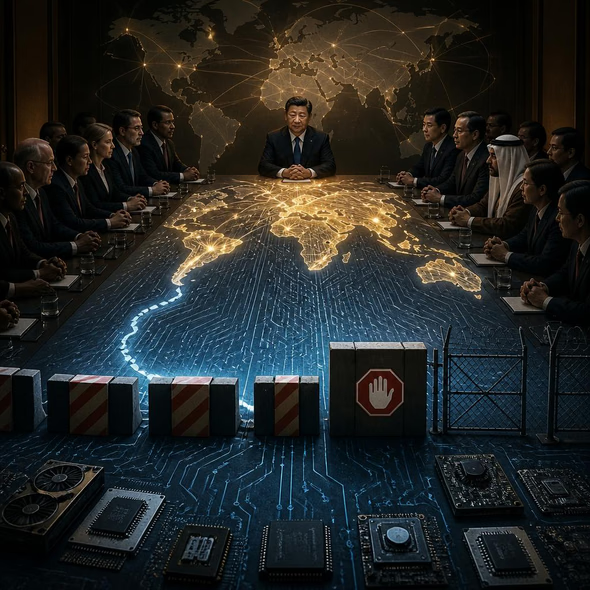
Xi Jinping’s call for greater international cooperation on artificial intelligence arrives with a useful architectural distinction. The United States and its partners retain considerable influence over the doors to advanced computing; China is proposing a larger conference room. The invitation may be sincere, strategic, or, most plausibly, both.
American-led restrictions have denied China access to some of the most advanced technology, according to NPR, increasing the pressure on Beijing to develop domestic alternatives. Cooperation language therefore serves an immediate interest. Rules written in a broader forum could dilute Washington’s ability to convert control of key technologies into control of the field’s acceptable boundaries.
The strongest case for the invitation
It would nevertheless be too easy to dismiss the proposal as diplomatic upholstery. Many governments consume AI systems, supply data, host infrastructure, or absorb labor disruption without exercising meaningful influence over technical standards and safety rules. If the practical choice is between a Chinese-backed forum and deliberations dominated by a small group of wealthy technology powers, participation in Beijing’s room may be rational even for states wary of its host.
That does not make the room neutral. China would gain legitimacy by presenting itself as the sponsor of inclusion while the United States is identified with exclusion. It could also encourage definitions of openness, sovereignty, and safety that suit Chinese institutions. Every international forum has a seating chart, an agenda, and someone who arranged both.
Governance under constraint
The difficult question is whether cooperation would reach the pressure points that matter: access to computing capacity, transparency about powerful models, enforcement of safety commitments, and the treatment of cross-border data. A declaration can distribute rhetorical ownership without redistributing technical power. The available reporting establishes the call for cooperation and the surrounding technological squeeze, but not the terms of a durable governance mechanism.
Washington faces its own contradiction. Export controls may slow a strategic competitor, yet a governance order that appears inseparable from those controls gives excluded countries a reason to seek another sponsor. Beijing does not need every government to trust it. It needs enough of them to conclude that the existing arrangement offers no chair.
The likely result is not a single global AI compact but competing institutions, overlapping standards, and governments bargaining between them. China’s conference room could become a genuine venue, an influence operation, or both at once. Its importance will depend less on the invitation than on who can shape the minutes after everyone sits down.
Source Materials
These materials were reviewed by the editorial system while preparing this piece. Muerte.casa may interpret, satirize, reframe, or disagree with them.
- China's Xi calls for step up of global effort in AI, as US curbs squeeze China's tech access NPR · July 17, 2026 · Primary signal
How did this story land?
This may be changed as you like.