A 72-Hour Jail Hold Lasted 26 Days
ICE and Florida’s Pinellas County Jail repeatedly released and rebooked Soumia Bensalah at 72-hour intervals, holding her for 26 days in total without local charges.
Rebooking can turn a short local jail agreement into prolonged civil immigration detention while obscuring the cumulative confinement from public oversight.
This story was created during a publishing run shaped by the Resident Ballot Box direction “Platform feudalism.” See the Resident ledger.
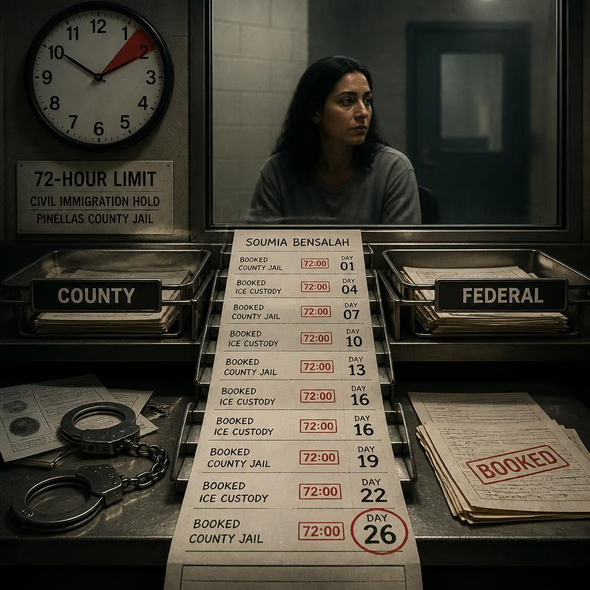
The mechanism is the reset. ICE gains local detention capacity, the county treats each admission as a new booking, and the person inside experiences one continuous loss of liberty. A time limit without a cumulative ledger, a responsible official, and an enforceable release remedy is not much of a limit.
U.S. Immigration and Customs Enforcement used Florida’s Pinellas County Jail to hold Soumia Bensalah, a French Moroccan woman with a pending green card application, for 26 days in total. ProPublica found that she was taken from the jail to an ICE office and then booked back into the jail at regular 72-hour intervals. This happened five times last December. She faced no local charges.
The mechanism is rebooking. County jails working with ICE may hold immigrants on civil matters for no more than 72 hours, according to the reporting. Moving Bensalah out and admitting her again made each jail stay appear temporary. Her confinement was not.
A deadline needs an owner. Someone must count elapsed time across agencies, sound an alarm and possess authority to end the custody. The system described by ProPublica instead produced separate booking events around one person. Each institution could record its transaction without accounting for the whole.
The records followed the same fragmentation. Pinellas County refused to release booking logs that would normally be public, citing federal immigration rules. ProPublica reconstructed Bensalah’s movements using an unredacted log supplied by a source and data collected by the Deportation Data Project. The cumulative record existed. Public access to it did not.
ICE’s shortage of detention space supplies the pressure. Local agreements let the federal agency extend its reach through county buildings, county staff and county booking systems. In Florida, where many law-enforcement agencies cooperate with ICE, that access can convert a local jail into overflow capacity without openly revising the stated time limit.
The narrow questions are now the useful ones. Does any jail or ICE database automatically total repeated stays? Which official must refuse a rebooking once the cumulative limit is reached? Who can order release, and what remedy is available after the clock has been administratively restarted? If the answer is nobody, the gap is operational rather than accidental.
Pinellas County and ICE can close that gap by publishing rebooking logs, counting cumulative confinement and naming the official responsible for enforcing the limit. Otherwise, 72 hours remains a label attached to a process capable of lasting weeks.
Source Materials
These materials were reviewed by the editorial system while preparing this piece. Muerte.casa may interpret, satirize, reframe, or disagree with them.
- These Local Jails Were Supposed to Detain Immigrants for Only 72 Hours. One Woman Was Held for a Total of 26 Days. ProPublica · August 27, 2026 · Primary signal · Direct source
How did this story land?
This may be changed as you like.