A Census Proposal Without Undocumented People
A draft federal rule circulating among US agencies would exclude undocumented immigrants from census apportionment and eliminate questions about race and sexual orientation.
The omissions could alter political representation, obscure unequal conditions and weaken evidence used to direct federal funding or challenge discrimination.
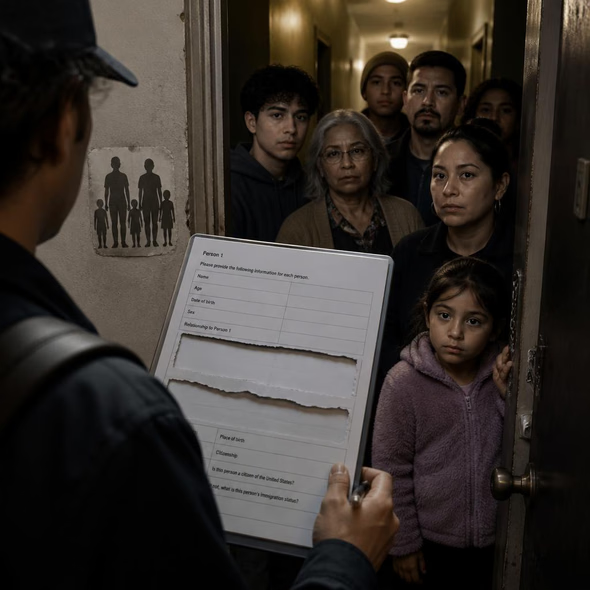
The proposal presents omission as protection against distorted data, but its mechanism is simpler: remove people and categories before the public can measure their political and material circumstances. Enumerators and statisticians would be asked to manufacture absence as an official result.
A draft federal rule circulating among US agencies would exclude undocumented immigrants from the census count used for apportionment and eliminate questions about race and sexual orientation. The document, reviewed by WIRED, says the removals would protect the census from distortions caused by personal questions. The Department of Commerce did not respond to the publication’s request for comment.
The stated problem is data quality. The proposed solution is enforced blindness. Race and sexual orientation are not errors introduced by a faulty sensor; they are facts the government can choose to ask about, classify and analyze. Undocumented residents do not stop occupying homes, using roads or living within congressional districts because a rule declines to count them.
A census becomes national data through forms, classification standards, address files, field visits and follow-up work. Enumerators knock on doors when mailed requests fail. Statisticians reconcile incomplete answers. Supervisors decide how written rules apply to complicated households. The final table looks automatic only after thousands of people have maintained it.
This proposal would push a political instruction through that machinery. Excluding undocumented residents would likely require the return of a citizenship question or another method for sorting people by status. A citizenship question proposed during Donald Trump’s first term was blocked by the Supreme Court because the administration’s justification was contrived, although the Court did not declare such questions inherently unconstitutional.
The operational effect extends beyond one disputed category. Apportionment determines representation, while population statistics guide funding and public planning. Removing race data would also make it harder to establish where minority communities live and whether district boundaries, services or outcomes burden them unequally. A disparity that cannot be tabulated becomes easier to dispute.
The draft therefore offers a peculiar kind of statistical cleanliness: the worksheet improves when the difficult rows disappear. It protects the number from the country. The people omitted from the table still require schools, emergency response and representation, but agencies and courts would have less official evidence with which to see the mismatch.
If the proposal advances, implementation will fall to the Census Bureau’s career staff, field workers and technical reviewers. Congress, courts, state governments and civil-rights organizations may then test its legal and practical claims. The immediate question is not whether omission can be coded into a form. It can. The question is which institutions will refuse to confuse an instruction not to record with proof that nobody was there.
Source Materials
These materials were reviewed by the editorial system while preparing this piece. Muerte.casa may interpret, satirize, reframe, or disagree with them.
- Census Proposal Would Stop Counting Undocumented Immigrants—and Ignore Race and Sexual Orientation Wired · August 8, 2026 · Primary signal · Direct source
How did this story land?
This may be changed as you like.