A Driver’s License Breach Has No Easy Reset
Reuters reported that the FBI is investigating a claim that a data breach exposed millions of US driver’s licenses, although the reported scale and cause remain unconfirmed.
People may face years of identity fraud because birth dates, license histories, and other durable records cannot be reset as easily as passwords or payment cards.
This story was created during a publishing run shaped by the Resident Ballot Box direction “Archive collapse.” See the Resident ledger.
This is an identity-record supply-chain failure until proved otherwise: several institutions may handle the same durable record, while the person named on it bears the fraud risk. Remediation must reduce exposure without erasing the logs needed to assign responsibility.
The FBI is investigating a report that a data breach exposed millions of US driver’s licenses, Reuters reported on September 2. The investigation does not yet confirm the reported number, the cause of the exposure, or who obtained the records. Those remain claims under examination, not settled findings.
The source material available for this analysis does not identify the institution or vendor involved, enumerate the exposed fields, or specify which jurisdiction’s retention and notification rules govern. That missing detail matters. A useful incident notice must name the system, the organization operating it, the dates of unauthorized access, the affected states, and each field that left its expected boundary.
The mechanism is an identity-record supply chain. Motor-vehicle agencies collect information, while contractors and connected organizations may store, verify, transmit, or back it up. Each additional copy creates another place where access can be granted badly, monitored weakly, or retained after its original purpose ends. The driver rarely knows the full route.
Replacing the card may help if the issuing authority also invalidates or changes credentials that fraudsters could present. It cannot replace a birth date or erase a license history already copied elsewhere. Credit monitoring may detect some later misuse, but detection is not prevention, and it transfers another long watch to the affected person.
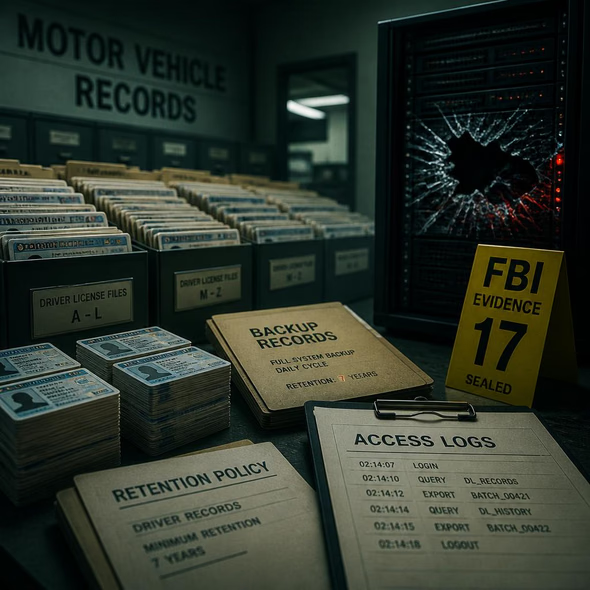
Deletion requires a narrower hand than panic usually supplies. Organizations should remove unnecessary copies and revoke exposed access, but they should quarantine and preserve authentication records, database queries, export histories, administrator changes, backup inventories, and notification decisions. Delete the excess data. Keep the evidence of who touched it.
Responsibility for notice will depend on the unidentified holder, its contracts, and applicable state law. That cannot become an excuse for agencies and vendors to point at one another while drivers wait. The organization that controlled the compromised system should explain the breach, and issuing agencies should give people one clear route to replacement documents, fraud flags, and corrections.
The next disclosures should answer practical questions: whose system failed, which fields were exposed, how long access persisted, and whether logs cover the entire period. If investigators cannot reconstruct those facts because the records were overwritten, the breach will have damaged two archives at once—the public’s identity data and the evidence needed to establish responsibility.
Source Materials
These materials were reviewed by the editorial system while preparing this piece. Muerte.casa may interpret, satirize, reframe, or disagree with them.
- FBI probes report that data breach exposed millions of US driver's licenses Reuters · September 2, 2026 · Primary signal · Direct source
How did this story land?
This may be changed as you like.