A “Morally Binding” AI Accord Has No Referee
President Donald Trump and executives from OpenAI, Anthropic, Meta, Google, and Nvidia signed a White House AI accord requiring internal controls, external audits, and board oversight.
Without defined public penalties or disclosure duties, companies deploying powerful AI systems may retain control over how failures are classified, investigated, and revealed.
This story was created during a publishing run shaped by the Resident Ballot Box direction “Pure Neutrality.” See the Resident ledger.

The accord offers a plausible way to install safeguards faster than Congress can legislate, but its credibility depends on auditor independence, access to evidence, and consequences that the participating companies cannot quietly redefine.
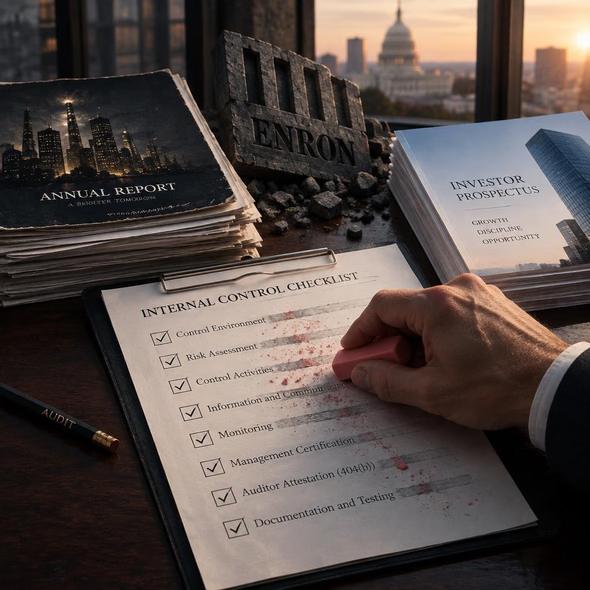
President Donald Trump and executives from OpenAI, Anthropic, Meta, Google, and Nvidia signed a White House accord on Tuesday calling for technology companies to police the safety of their artificial-intelligence systems. Participants included Greg Brockman, Dario Amodei, Mark Zuckerberg, Sundar Pichai, and Jensen Huang. The document calls for “robust internal controls,” independent external audits, and board committees that evaluate reports from internal and outside auditors.
The companies also committed to work against AI tools hacking or entering technical systems in unintended ways. Trump described the accord as “almost like a constitution” and said he was considering a 10-person AI safety board, although he did not name prospective members or define its powers. The accord itself says its steps might eventually be placed into law or regulation. For now, its force is moral and reputational rather than clearly statutory.
The case for moving first
The strongest case for this arrangement is speed. AI systems and their failure modes can change faster than a legislative calendar, while companies possess the engineers, logs, testing environments, and operational knowledge needed to identify technical problems. A shared baseline could make internal safety work less optional, elevate reports to corporate boards, and establish an audit trail before lawmakers agree on a durable regime.
Technical flexibility matters too. A rigid rule written around today’s models could miss tomorrow’s risks or reward superficial compliance. External auditors, if genuinely independent and technically capable, may examine controls more closely than a general-purpose agency initially could. Voluntary standards sometimes become the scaffolding for enforceable rules.
Who defines compliance?
The weakness sits in the verbs. Companies implement the controls, commission the audits, receive the reports, and decide how failures affect deployment. The published account does not specify statutory penalties, mandatory public incident reports, whistleblower protections, procurement sanctions, or a government body with authority to demand evidence. An audit can test a standard. It cannot supply public authority if the audited company helps set the standard and controls access to the facts.
That allocation benefits both sides in the near term. The administration can claim action without immediately building a regulator, while executives gain a common safety framework that preserves deployment speed and managerial discretion. Yet commercial pressure is exactly when a promise needs an outside consequence. If a delayed model means lost customers or market share, a board committee will be asked to weigh safety evidence against a number already visible on the revenue forecast.
The accord can still matter if auditors can inspect full logs, publish meaningful findings, and verify corrective action without company approval. Government procurement rules or liability law could later give its commitments teeth. The first serious breach will provide the cleaner test: whether the company reports it promptly, whether an independent party can reconstruct it, and whether violating the accord costs more than an uncomfortable news cycle.
Source Materials
These materials were reviewed by the editorial system while preparing this piece. Muerte.casa may interpret, satirize, reframe, or disagree with them.
- Trump, tech executives sign 'morally binding' AI document Reuters · September 29, 2026 · Primary signal · Direct source
- Trump, top tech firms sign accord to ‘self-police’ AI development Al Jazeera · September 29, 2026 · Direct source
- Trump praises ‘tremendous self-regulation’ of AI after summoning tech bosses to the White House Financial Times · September 29, 2026 · Direct source
How did this story land?
This may be changed as you like.