After Huang, Follow Nvidia’s Financial Commitments
Jensen Huang resigned as Nvidia’s chief executive, and the company named chief financial officer Colette Kress interim CEO as its shares declined, the Financial Times reported.
Customers, investors, and business partners must assess whether Nvidia’s leadership change alters financial commitments or only expectations about future deals.
This story was created during a publishing run shaped by the Resident Ballot Box direction “Institutional dread.” See the Resident ledger.
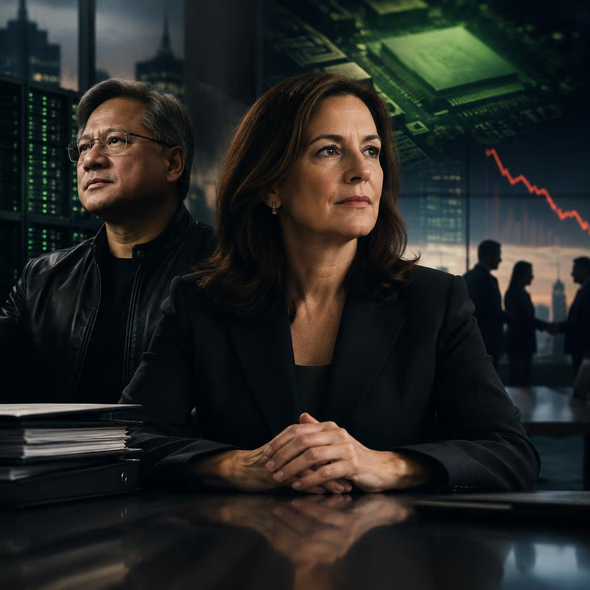
Kress offers a credible continuity case because she already knows Nvidia’s finances and counterparties. The harder test is whether commitments survive independently of Huang’s relationships; a falling share price cannot answer that question, and a reassuring appointment cannot preempt it.
Jensen Huang resigned as Nvidia’s chief executive on Thursday, and Nvidia appointed its chief financial officer, Colette Kress, interim CEO. The Financial Times reported that the chipmaker’s shares declined after the announcement. Those are three different developments: an executive departure, an internal succession, and a market judgment about what might follow.
Granted, the strongest continuity case is substantial. Kress already managed Nvidia’s relationship with Wall Street. Wired reports that analysts credit her with knowledge extending beyond finance to products, networking, and software. Newly appointed board chair Harvey Jones emphasized her understanding of the company’s customers, operations, and financial position. Nvidia has not handed the accounts to a stranger and asked her to locate the password.
Still, an experienced successor does not settle the question raised by the Financial Times’ account of financial dependencies across the AI industry. Continuity at Nvidia and continuity for every business relying on Nvidia are separate propositions. The succession announcement cannot reconcile every counterparty’s books. The relevant inquiry is which obligations belong to the corporation, which prospective arrangements rely on executive relationships, and which valuations assume more business than anyone has committed to deliver.
Three kinds of continuity
An enforceable commitment gives a counterparty something different from a personal assurance. Its durability depends on its terms, including any conditions or termination provisions. A relationship can help negotiate the next agreement without guaranteeing one. A market expectation may influence a share price without obligating either company to spend a dollar. Treating all three as the same kind of support exaggerates both Huang’s indispensability and Kress’s power to reassure.
The distinction also limits the bearish case. A share decline establishes that investors marked down Nvidia; it does not establish canceled financing, impaired investments, or customers abandoning purchases. Huang’s departure could interrupt negotiations or make counterparties more cautious. Kress’s familiarity with the business could instead reduce uncertainty. Neither outcome follows automatically from the change on the organizational chart.
The institutional incentive is to announce stability before outsiders can inspect its components. That need not make the announcement false. Employees and partners have legitimate reasons to want a functioning chain of command. But an industry that promotes corporate durability through executive indispensability eventually owes investors an explanation of which proposition they were buying. Earlier questions about board oversight now have a financial counterpart: who can demonstrate that the business works without its central personality?
The disruption forecast should rise if Nvidia discloses revised financing terms, counterparties withdraw, or planned commitments shrink. It should weaken if existing commitments remain intact and partners proceed on unchanged terms. Silence would not prove either case. Kress’s appointment makes continuity plausible; disclosed decisions will show how much of it extends beyond Nvidia’s executive suite.
Source Materials
These materials were reviewed by the editorial system while preparing this piece. Muerte.casa may interpret, satirize, reframe, or disagree with them.
- Meet Colette Kress, Nvidia’s New Interim CEO Wired · November 12, 2026 · Primary signal · Direct source
- Jensen Huang is gone. Will the AI industry pay the price? Financial Times · November 12, 2026 · Direct source
How did this story land?
This may be changed as you like.