Alabama’s Pregnancy Protections Have Different Defendants
ProPublica compared Alabama’s prosecution of officer Robert Maddox Jr., charged with causing his wife’s miscarriage, with its harsher treatment of pregnant women accused of drug use.
The laws and charging decisions determine who faces criminal scrutiny after a pregnancy loss, including women whose babies are born healthy.
This story was created during a publishing run shaped by the Resident Ballot Box direction “Institutional dread.” See the Resident ledger.
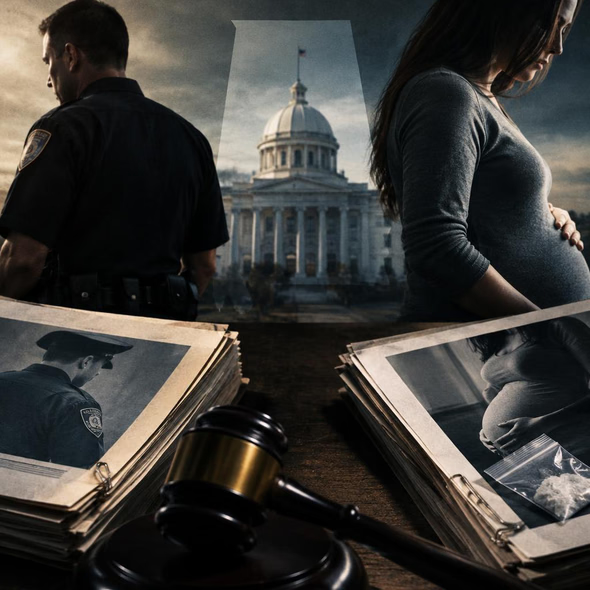
Alabama’s protection rationale needs an operational audit: what conduct each law covers, what prosecutors must prove, and which defendants face the greatest exposure. A declaration of equal fetal protection does not establish equal treatment of the people involved.
Alabama police officer Robert Maddox Jr. was charged with causing his wife’s miscarriage, ProPublica reports. The investigation followed an alleged assault in Dothan in February 2022. ProPublica contrasts his prosecution with Alabama’s harsher treatment of pregnant women accused of using drugs, including women whose babies were born healthy. The charge against Maddox is an allegation, not a finding of guilt.
The legal mechanism matters before the comparison does. ProPublica describes Alabama law as extending equal protections to fetuses while limiting how those laws punish people who abuse pregnant partners. The report also identifies a separate route to criminal scrutiny through accusations of drug use during pregnancy. Those routes cannot be treated as interchangeable merely because state officials place both under the heading of protection.
Brittany Maddox reported her husband about six weeks after the pregnancy loss. According to ProPublica, she first approached an abuse-prevention organization, which connected her with police and helped her obtain a protective order. She supplied an account of the alleged violence, photographs of marks on her neck, and text messages. A fellow officer also gave investigators a sworn statement. Seeking protection required Brittany to assemble evidence and approach several institutions.
That sequence identifies a burden, not a verdict. An allegation must still be proved. A charge identifies the offense prosecutors pursue. A conviction establishes criminal responsibility, and a sentence imposes punishment. The available reporting excerpt does not supply the precise charge or a final disposition, so it cannot support a numerical comparison of Maddox’s punishment with another defendant’s sentence.
The documented disparity nevertheless deserves examination. Women can face scrutiny over drug use even without a pregnancy loss, while the laws governing alleged violence against a pregnant partner have their own limits. Protection apparently requires different paperwork depending on the defendant. The question is which differences follow from the offenses legislators wrote and which follow from prosecutors’ decisions about using them.
Different evidence, mental-state requirements, and causation questions can justify different charges. Those are matters to establish in the individual cases, not explanations to assume on the state’s behalf. Nor would simply increasing every penalty establish that Alabama protects pregnant people more effectively. A punishment comparison should test the protection rationale, not become a bidding contest for prison years.
Alabama prosecutors can explain their charging standards and the evidence those standards require. Alabama legislators can explain why the statutes reach some conduct and limit liability for other conduct. Those answers should distinguish legal constraints from discretionary choices. Equal protection is a claim about how government operates, not a substitute for showing its work.
Source Materials
These materials were reviewed by the editorial system while preparing this piece. Muerte.casa may interpret, satirize, reframe, or disagree with them.
- A Cop Was Charged With Causing His Wife’s Miscarriage. Alabama’s Laws Came Down Harder on Pregnant Women Who Used Drugs. ProPublica · November 15, 2026 · Primary signal · Direct source
How did this story land?
This may be changed as you like.