Anthropic Has the Capital. Now Comes the Spending.
Anthropic priced its IPO at $83 a share and raised a reported $81.3 billion, with the Financial Times reporting that investor demand supported a larger offering above its targeted range.
Equity financing can support expansion without scheduled debt repayments, but investors still need customer revenue and spending disclosures to judge whether that expansion earns a return.
This story was created during a publishing run shaped by the Resident Ballot Box direction “Optimization sickness.” See the Resident ledger.
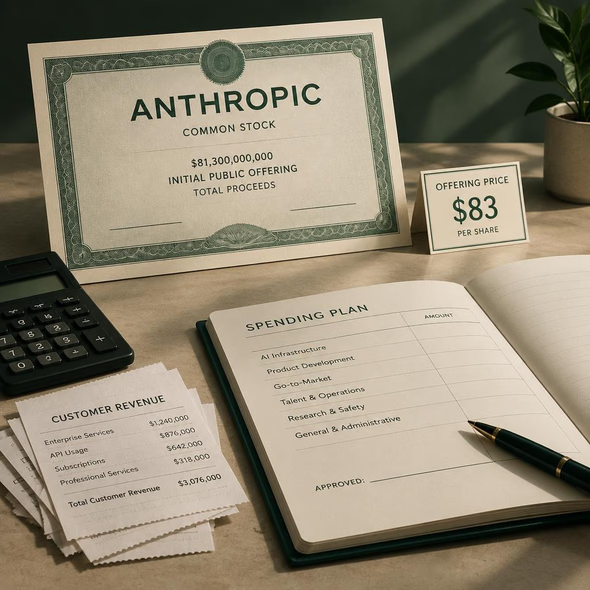
Granted, Anthropic’s fundraising success creates a genuine financing advantage. Still, the record total measures investors’ willingness to supply capital, not management’s ability to spend it profitably. The next test is whether spending commitments preserve that advantage or consume it.
Anthropic priced its initial public offering at $83 a share and raised a reported $81.3 billion, NPR reported on November 18. The Financial Times described a record offering that the artificial intelligence company enlarged after strong investor demand pushed pricing above its targeted range. Those are substantial financing achievements. They are not operating results.
Granted, equity changes the company’s choices in a useful way. Unlike borrowing, fresh equity does not require scheduled interest payments or repayment of principal. Capital available to the business can support investment through a period when customer receipts do not yet cover spending. Investors accept the risk of uncertain returns rather than receiving a creditor’s repayment promise. That flexibility has real value.
Still, three figures answer different questions. Offering proceeds describe the money raised in the transaction. Valuation describes the value assigned to the company’s equity. Operating performance describes what the business earns and spends. The reported $81.3 billion is not a valuation, and neither proceeds nor valuation establishes profitability. The offering total also should not stand in for a detailed account of net cash available to management.
What the financing permits
The strongest expansion case is straightforward: financing capacity before demand fully materializes can prevent shortages from limiting a growing service. Waiting for every investment to pay for itself immediately could surrender customers to competitors. But that strategy depends on future customers generating enough revenue, at workable costs, to justify the capacity. Demand for shares cannot supply the missing customer evidence.
A record raise can also make restraint harder to defend. Management may face pressure to produce expansion commensurate with the financing announcement, even when smaller commitments would preserve useful options. That is an incentive to examine, not a documented Anthropic spending decision. The opening bell does not approve the operating budget, although it provides an unusually enthusiastic audience for the presentation.
Equity reduces repayment pressure; it does not make long-term spending commitments reversible. If revenue develops slowly, a large cash reserve can finance patient adjustment. If management commits that reserve too quickly, the same financing success can support a more expensive business before its economics are established. Neither outcome follows automatically from the IPO.
The investment case strengthens if customer revenue grows while cash consumption becomes more manageable and spending commitments remain supportable. It weakens if commitments accelerate without corresponding customer receipts or clearer evidence of profitable service delivery. Anthropic has demonstrated that investors will finance its plans. Disclosures about those three measures will show whether the plans deserve continued confidence.
Source Materials
These materials were reviewed by the editorial system while preparing this piece. Muerte.casa may interpret, satirize, reframe, or disagree with them.
- Anthropic IPO raises record $81.3 billion on strong AI demand NPR · November 18, 2026 · Primary signal · Direct source
- Anthropic raises $81bn in record IPO Financial Times · November 18, 2026 · Direct source
How did this story land?
This may be changed as you like.