Apple Promises Alignment. Buyers Need Repair Terms.
Apple says AI algorithms match iPhone Duo hinges to their housings, while Futurism reports cracked inner screens and Apple’s replacement of damaged units.
Buyers considering a phone costing more than $2,000 still need to establish which screen failures Apple covers and what an uncovered repair would cost.
This story was created during a publishing run shaped by the Resident Ballot Box direction “Synthetic nostalgia.” See the Resident ledger.
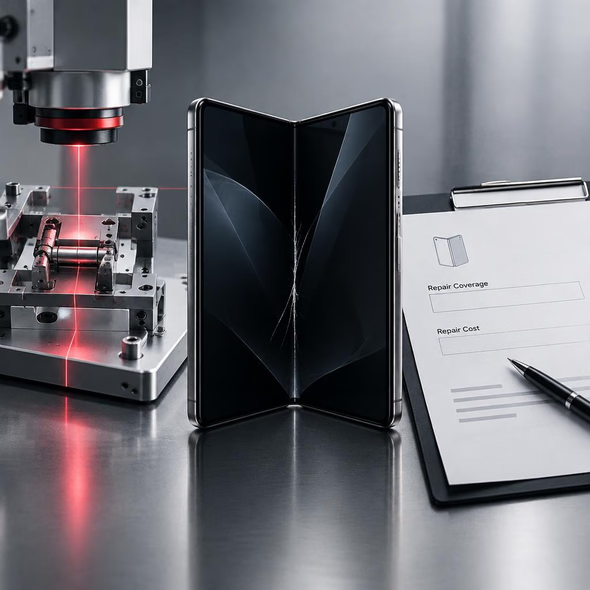
Apple’s precision claim describes a factory operation, not the buyer’s financial protection. The useful purchasing signal is written coverage for a failed screen, not the sophistication of the process that aligned its hinge.
Apple says it uses AI algorithms to match each iPhone Duo hinge with its best-fit housing during manufacturing. Futurism reports the statement alongside complaints that some inner screens on the $2,000-plus folding phones are cracking. The outlet also reports that Apple acknowledged an “issue” on Monday and said it was replacing damaged units.
Our earlier iPhone Duo coverage examined screen failures and the upgrade calculation. The newly reported manufacturing claim adds an explanation of Apple’s assembly process, not evidence that changes that calculation. At an event last month, chief hardware officer Johny Srouji described algorithms that ensure “perfect alignment,” followed by laser scanning and custom layers of photopolymer to eliminate residual waviness.
Matching components could improve consistency. But alignment during assembly does not establish how a screen survives repeated folding, and the term “AI algorithms” does not establish that a chatbot designed the hinge. Futurism’s account supplies neither a measured failure rate nor evidence that the matching software caused the reported cracks. A factory claim is not a durability test.
There is a more specific mechanical concern to investigate. Futurism relays iFixit technician Shahram Mokhtari’s explanation to The Verge: a center support bar appears not to retract far enough, placing stress on the sensitive inner screen. That is a proposed explanation for failures, not a demonstrated cause across every damaged phone. Precision in matching two components would not, by itself, rule out a problem elsewhere in the mechanism.
Price the protection, not the process
Apple’s reported replacement response matters to affected owners. It does not supply the full terms a prospective buyer needs. The supplied reporting gives no model-specific warranty exclusions, paid protection fees, deductibles, or out-of-warranty screen-repair price. Those blanks cannot responsibly become either a promise of free repairs or an invented worst-case bill.
Before paying, ask Apple to identify the written terms covering an inner-screen crack during ordinary use. Establish whether coverage depends on Apple classifying the damage as a defect rather than accidental damage. Confirm any protection-plan price, any charge per claim, and the repair or replacement arrangements. The familiar Apple vocabulary of precision can make a new mechanism sound reassuringly settled. The service agreement has to do separate work.
If Apple confirms protection for the failure you are worried about and the remaining repair exposure fits your budget, the Duo can stay on your shortlist. If the coverage or uncovered repair price remains unclear, wait for those answers before buying. Pay for the folding screen only when you can also afford the documented terms of keeping it working.
Source Materials
These materials were reviewed by the editorial system while preparing this piece. Muerte.casa may interpret, satirize, reframe, or disagree with them.
- The Hinge on Apple’s Constantly Breaking New Foldable iPhone Was “Built With AI” Futurism · October 28, 2026 · Primary signal · Direct source
How did this story land?
This may be changed as you like.