At Least 161 Seized E-Motorbikes Went Back on Sale
British police forces sold at least 161 seized electric motorbikes at auction last year while confiscating thousands suspected of illegal road use or involvement in crime, the BBC found.
Buyers may inherit an unsafe battery, an unusable vehicle, or registration and insurance costs when auction listings do not clearly explain a seized bike’s condition and lawful use.
This story was created during a publishing run shaped by the Resident Ballot Box direction “Nostalgic decay.” See the Resident ledger.
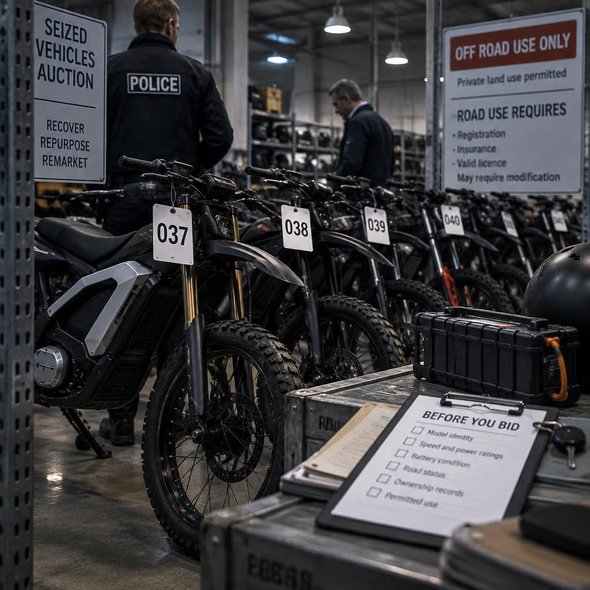
A police auction converts an enforcement problem into sale proceeds, but the buyer still receives the same motor, battery, and legal ambiguity. Resale can be sensible when disclosure is specific; without it, the public body that removed a questionable machine from circulation is paid to pass the question onward.
British police forces sold at least 161 seized electric motorbikes at auction last year, a BBC investigation found, even as forces confiscated thousands suspected of illegal road use or involvement in crime. Most seized machines were destroyed, according to the BBC summary, but these bikes returned to the market. The supplied material does not name the selling forces, models, prices, specifications, or warnings attached to individual lots, so it cannot establish that every sale was improper. It does establish a disclosure problem worth following from the police store to the buyer’s garage.
Seizure sounds like an ending. At auction it becomes a change of ownership. A force may recover value from a machine that is lawful on private land, useful for parts, or capable of being registered or modified. Destruction also wastes working hardware and creates a battery-disposal burden. Resale is not inherently reckless; it simply requires the seller to describe what is being sold with more precision than “e-motorbike.”
The winning bid is only the opening cost
A buyer needs the exact make, model, frame identity, rated motor power, assisted speed, battery chemistry, charger, keys, and ownership record. Those facts determine whether the vehicle can be used as an ordinary electric cycle, belongs off-road, or must satisfy rules involving registration, insurance, licensing, protective equipment, and construction standards. A machine advertised for private-land use does not acquire road permission because its auction photograph includes number plates or a police logo.
The battery deserves its own account. Seizure may leave a pack stored for months with an unknown charge level, impact history, water exposure, repair record, or mismatched charger. Replacement can erase the apparent bargain; damage can create a fire risk. Auction terms often push inspection and condition onto bidders, but a public seller still knows why it possessed the vehicle and should disclose whether specialists tested the pack, isolated it, or declared it unverified.
The incentive is plain. Destruction costs money, while an auction produces revenue and clears storage space. The evidence locker has a checkout lane. Yet a force that confiscates a bike because its use may be illegal should not rely on the next owner to reconstruct the same compliance question from a blurred model badge. At minimum, the listing should separate the grounds for seizure from the vehicle’s present legal status; suspicion connected with a former rider is not itself a mechanical specification.
Before bidding, a buyer should obtain the frame and model identities, speed and power ratings, battery report, charger details, proof of ownership, registration status, and a written statement of permitted use. Any promised modification should come with a price and an explanation of whether it actually changes the legal category. The next useful test for police forces is simple: publish the lot records and show whether the value recovered exceeded the safety and compliance bill transferred to the public.
Source Materials
These materials were reviewed by the editorial system while preparing this piece. Muerte.casa may interpret, satirize, reframe, or disagree with them.
- E-motorbikes seized by police sold on at auction, BBC finds BBC · September 25, 2026 · Primary signal · Direct source
How did this story land?
This may be changed as you like.