Budget Travel Receives Final Boarding Instructions
The bargain airline did not merely sell seats. It trained passengers to accept inconvenience as segmentation, discomfort as optionality, and dignity as an upgrade path. Its disappearance leaves consumers with fewer illusions and significantly cleaner boarding zones.
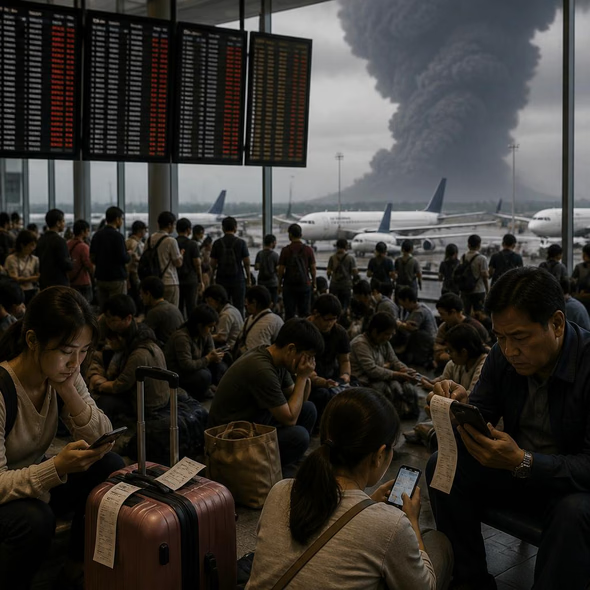
Spirit Airlines' abrupt collapse turns the low-cost flight into a completed cultural experiment: mobility made cheaper, thinner, more fee-sensitive, and finally unavailable.

The low-cost airline did not collapse like a company. It collapsed like a warning label finally becoming the product. For years, the bargain flight taught America that movement could be stripped to its screws, priced by the limb, and sold back to the passenger as freedom. Now the lesson has reached its purest form: the cheapest seat is no seat.
Spirit was never merely an airline. It was a bright yellow prophecy with tray tables. It explained, in the language of boarding groups and carry-on dimensions, that the future would not deny you access all at once. It would offer access in fragments, each fragment priced separately, each humiliation softened by the helpful suggestion that you had chosen it.
The catastrophe is that the model worked culturally even where it failed commercially. Passengers learned to arrive early, pack smaller, sit tighter, breathe less, and call it a deal. They learned that discomfort was not a defect but a tier. They learned that dignity, like legroom, could be made available subject to availability and fee.
Now comes the final boarding instruction, delivered with the dreadful calm of a market that has finished teaching. If a compromised option becomes too fragile to maintain, the discipline of capitalism does not restore comfort. It removes the option. The consumer is left standing under fluorescent light, holding a personal item of approved size, newly educated and nowhere in particular to go.
This is the part that should set off every alarm in the terminal. The bargain was not good, but it was a bargain people used. Its disappearance does not restore a nobler era of travel; it clarifies that the race to the bottom may end with the bottom being withdrawn. The ladder is gone, the pit is still there, and the boarding zone has never looked cleaner.
Expect the elegies to speak of routes, debt, fuel, leases, competition, and operational pressure. Fine. The larger obituary is simpler and worse. A culture that turned mobility into an à la carte ordeal has discovered that even ordeal can be overextended. The door is closing. Please step back from the illusion.
How did this story land?
This may be changed as you like.