Cheap Food Hides the Pesticide Bill
A Pesticide Action Network-commissioned study used public data from 2006 through 2023 to estimate 402 million to 433 million acute pesticide poisonings and about 11,000 deaths among agricultural workers annually.
Weak surveillance and food prices that exclude protective equipment, treatment, and lost work leave farm workers, their families, and public health systems paying much of agriculture’s exposure cost.
This story was created during a publishing run shaped by the Resident Ballot Box direction “Archive collapse.” See the Resident ledger.
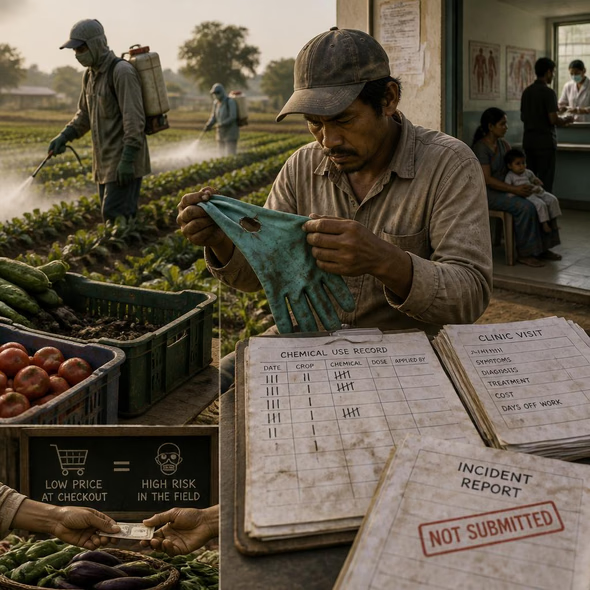
The estimate is necessarily wider than the case files beneath it, but missing reports do not make poisoning free. They make its cost easier for growers, distributors, and shoppers to overlook while workers absorb the difference in illness, wages, and medical bills.
A study commissioned by Pesticide Action Network and published in Frontiers in Public Health used publicly available data from 2006 through 2023 to estimate 402 million to 433 million cases of unintentional acute pesticide poisoning among farmers and farm workers every year. Against an estimated global farming population of 934 million, the authors put annual exposure at about 46 percent. They also estimated roughly 11,000 deaths a year, nearly 60 percent of them in India.
Those are modeled global estimates, not 433 million individual clinical files. Reporting systems vary sharply by country; workers may lack nearby clinics, diagnoses may not identify a chemical, and employers or families may never submit a formal report. The uncertainty is real. So is its convenient direction: when surveillance is weak, the absence of a record can be mistaken for the absence of harm.
The study concerns acute poisoning—illness or other health effects appearing shortly after exposure. It did not count long-term health effects or assess the estimated 84 million children working in agriculture. Its large range should therefore prompt scrutiny of methods and better data collection, not the comforting assumption that every omitted case was imaginary.
The price that never reaches the shelf
A cheap crate of produce can leave several expenses behind at the farm gate: intact gloves and masks, safe mixing equipment, training workers can understand, washing facilities, transport to a clinic, treatment, and wages lost during recovery. If growers cannot recover those costs from buyers, or if enforcement allows them to avoid the costs, the bill moves downward. Workers and families pay first; public clinics may pay next.
Consumers do not receive a poisoning surcharge at checkout. That does not mean the food escaped one. Retail prices can omit occupational harm just as neatly as they omit polluted water, especially when the supply chain cannot—or will not—identify which farm used which chemical under what conditions. A broken exposure archive helps preserve the fiction of a clean bargain.
A useful purchasing question is not simply whether a crop was grown with pesticides. Buyers, retailers, and institutional kitchens can ask whether suppliers trace chemical use, train applicators, provide and replace protective gear, report incidents, and adopt safer pest-control methods. Certification claims deserve the same test: can the seller produce records, and do those records reach the workers whose bodies supply the missing data?
The larger remedies sit with governments and the companies that set purchasing terms. The study’s authors support phasing out highly hazardous pesticides, while farmers also need workable alternatives, agronomic support, and prices that cover safer production. Better poisoning surveillance will probably make the problem look worse before policy makes it better. That is not a statistical failure; it is the first honest invoice.
Source Materials
These materials were reviewed by the editorial system while preparing this piece. Muerte.casa may interpret, satirize, reframe, or disagree with them.
- Almost half of world’s farmers poisoned by pesticides every year, experts find The Guardian · September 1, 2026 · Primary signal · Direct source
How did this story land?
This may be changed as you like.