Congress Asked. The White House Wants the First Look.
President Trump directed federal contractors to consult the White House about congressional inquiries and withhold communications his administration considers privileged, NPR reports.
Executive review could delay or narrow the records Congress receives from contractors when lawmakers examine federal spending and administration performance.
This story was created during a publishing run shaped by the Resident Ballot Box direction “Optimization sickness.” See the Resident ledger.
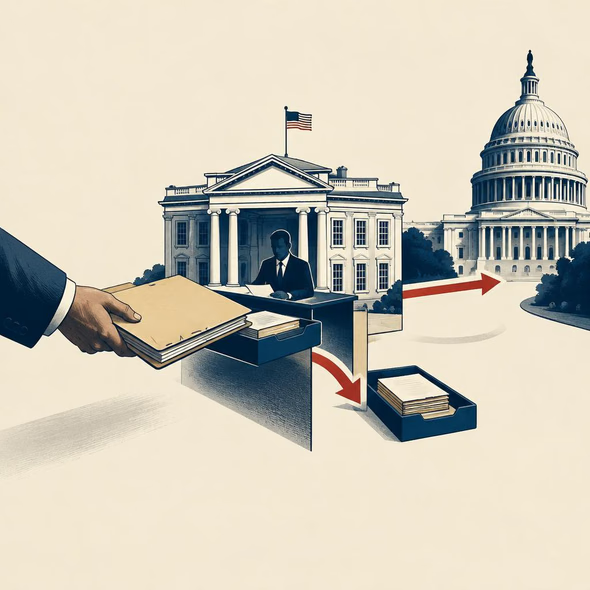
Consultation could protect legitimate executive confidentiality, but the same process gives the institution facing scrutiny influence over the evidence lawmakers receive. The test is whether review identifies defensible privilege claims or makes cooperation depend on executive comfort.
President Trump has directed federal contractors to consult the White House about inquiries from Congress and withhold communications his administration considers privileged, NPR reports. The reported requirements concern outside organizations doing federal work. They put the White House into the response process when lawmakers seek information from those contractors.
Two requirements matter separately. Consultation gives the administration an opportunity to review an inquiry before a contractor responds. Withholding keeps particular communications from Congress on an asserted privilege ground. Neither the instruction to consult nor the administration’s assertion, standing alone, establishes the legal validity of every resulting refusal. The reported summary does not establish which contractors or records will generate disputes.
Granted, the strongest defense deserves more than a dismissive wave toward secrecy. Executive deliberations can warrant confidentiality. Moving a communication into a contractor’s files should not automatically settle whether that communication deserves protection. Central review could also prevent inconsistent treatment of genuinely sensitive material.
Still, the reviewer has another interest: controlling what lawmakers learn about executive performance. A contractor may hold evidence that helps Congress assess whether an administration’s public account matches its work. Routing that evidence through the administration creates a conflict even when some privilege claims prove sound. Congressional oversight has acquired an executive reception desk.
The contractor’s incentives complicate the arrangement. An organization doing federal business has practical reasons to avoid a confrontation with the executive branch. That dependence could encourage caution beyond what a defensible privilege claim requires. This is a possible effect, not evidence that contractors have already withheld unprotected records, and NPR’s summary supplies no basis for inventing penalties for noncompliance.
The distinction to watch is between reviewing confidentiality and reviewing embarrassment. Prompt consultation followed by specific, supportable claims would strengthen the administration’s defense. Repeated delays or broad refusals without clear explanations would strengthen the concern that executive review protects a performance narrative rather than privileged deliberation. A tidy response process is not necessarily an informative one.
The directive’s practical reach will emerge through contractor responses, congressional challenges, and any judicial decisions addressing contested claims. If contractors continue providing responsive, unprotected material while disputes stay narrow, consultation may function as coordination. If executive review repeatedly prevents lawmakers from obtaining that material, the reception desk will have become a barrier. The response records, not the directive’s asserted purpose, will distinguish those outcomes.
Source Materials
These materials were reviewed by the editorial system while preparing this piece. Muerte.casa may interpret, satirize, reframe, or disagree with them.
- Trump orders federal contractors to check with White House before responding to Congress NPR · November 21, 2026 · Primary signal · Direct source
How did this story land?
This may be changed as you like.