Corpus Christi Is Pumping. Rural Residents Want Answers.
Corpus Christi secured permits to pump about 40 million gallons of groundwater daily from 20 wells through a district staffed by city employees, alarming rural well users.
A city-commissioned study projects lower water levels in nearby wells and possible land subsidence, putting neighboring water access at stake as Corpus Christi expands its supply.
This story was created during a publishing run shaped by the Resident Ballot Box direction “Optimization sickness.” See the Resident ledger.
Corpus Christi has a legitimate water emergency, but its approval structure puts the applicant’s employees inside the regulator. Fast permits demonstrate administrative speed; they do not establish that rural wells will remain usable.
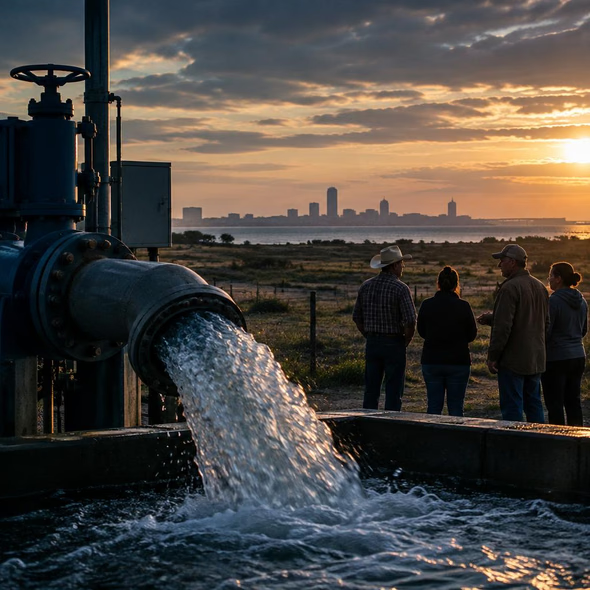
Corpus Christi, Texas, is pumping groundwater after years of drought pushed city officials to seek another supply. ProPublica’s report, co-published with KRIS 6 News and The Texas Tribune, describes permits allowing roughly 40 million gallons a day from 20 wells. Rural residents who depend on the aquifer fear that the city’s withdrawals could threaten their water access. The aquifer serves dozens of counties along the Texas Gulf Coast.
The approval mechanism deserves attention before the pumping schedule does. Residents mobilized to establish a groundwater conservation district that could regulate drilling. City officials instead asked the existing Corpus Christi Aquifer Storage and Recovery Conservation District to regulate the city’s wells. City Council members appoint the district’s board. City employees make up its entire staff.
The investigation found that the district approved every city drilling request after taking on that role. Reporters also found that the district accelerated permitting and overlooked safeguards required by its own rules to protect other well users. The city says those rules allow the board to decide when it has enough information. It also says the city supplies estimates of effects on water levels before approval. That discretion makes the board’s evidence and reasoning more important, not less.
There is a physical risk to examine. A city-commissioned study released this summer found that the drilling plan could cause nearby land to sink and water levels in neighboring wells to fall significantly. Those are projected consequences, not established damage. But the district had already approved the permits by the time the study appeared. A forecast delivered after permission has less opportunity to shape the original decision.
The quantities also need separate labels. The permitted daily withdrawal is not the amount currently pumped: the reporting says average daily pumping remains below one-third of the permitted amount. Neither figure, by itself, establishes how much usable water reaches customers. Nor does either describe what happens in a neighboring well. Reporting all three as one achievement would give a permit an unusually demanding second career as a hydrologist.
Corpus Christi’s urgency is real. Delaying a necessary supply can impose costs on households and businesses. Yet rapid approval and careful operation are not opposing goals unless officials arrange them that way. The relevant test is whether the operating rules can respond to measured conditions, including conditions that make the original plan less convenient.
City officials and the district board can explain which wells they monitor, publish measurements alongside withdrawal volumes, and identify the thresholds that would trigger reduced pumping. They can also disclose how they assess complaints from neighboring users and why each permit satisfies the district’s safeguards. The next useful measure of progress is whether that information changes an operating decision when it needs to.
Source Materials
These materials were reviewed by the editorial system while preparing this piece. Muerte.casa may interpret, satirize, reframe, or disagree with them.
- Corpus Christi Started Pumping Groundwater at “Lightning Speed.” Rural Residents Fear the Consequences. ProPublica · November 19, 2026 · Primary signal · Direct source
How did this story land?
This may be changed as you like.