What Does “Cost per Kill” Leave Out?
Wired profiled Henrijs Dandzbergs, whose startup Polemos Industries joined Y Combinator and aims to develop inexpensive AI-guided missiles for the US and allied militaries.
Cheaper missiles could stretch defense budgets, but purchasing decisions also determine reliability, civilian risk, and whether military spending supports a defensible objective.
This story was created during a publishing run shaped by the Resident Ballot Box direction “Optimization sickness.” See the Resident ledger.
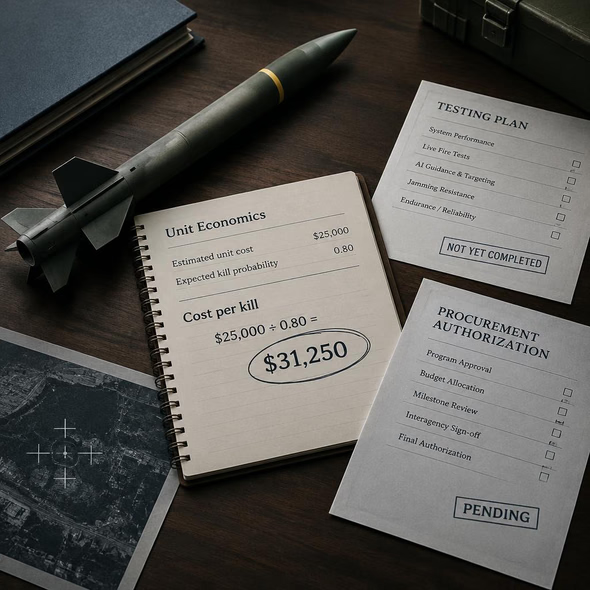
Affordability is a legitimate military requirement, not an adequate command principle. Polemos’s efficiency case should turn on independently tested performance and fully counted costs, while target legitimacy and strategic purpose remain separate judgments.
Henrijs Dandzbergs, a Latvian-born 16-year-old, left high school and entered Y Combinator’s fall 2026 cohort with Polemos Industries, Wired reports. His startup aims to supply the US and allied militaries with a new AI-guided missile. Polemos is attempting to develop a precision weapon that manufacturers could produce cheaply and easily, troops could fire from portable launchers, and adversaries would struggle to jam.
Those are development goals, not established battlefield capabilities. Wired’s supplied account describes accelerator backing and an investor one-pager that names the governing ambition: bring down the “cost per kill.” Neither admission to Y Combinator nor an investor’s confidence establishes military acceptance, demonstrated reliability, or a procurement commitment. The distinction matters more than the founder’s age.
Granted, the strongest affordability argument deserves more than an embarrassed footnote. A military that spends less for equivalent, dependable capability could buy deeper reserves or preserve money for training, maintenance, and other defenses. An expensive weapon is not more discriminating merely because its invoice looks serious. If Polemos can deliver comparable performance at a lower total cost, military buyers would have a reason to consider it.
Still, “cost per kill” leaves essential definitions unstated. What costs enter the numerator: the missile alone, or also launch equipment, training, storage, and failed attempts? What counts in the denominator, and who verifies the result? Different definitions could produce very different claims about the same weapon. Without those definitions, the metric offers the precision of a decimal point without the inconvenience of a settled calculation.
Even a rigorously calculated figure cannot establish whether a target is lawful or whether striking that target serves a military objective. Nor can an average establish reliability across the conditions troops may encounter. If buyers reward a lower ratio without protecting those other requirements, suppliers could face pressure to optimize the measurable result rather than the whole mission. That is an incentive risk, not evidence that Polemos has cut corners.
The strategic question is larger still. A cheaper successful strike might improve defense, but making strikes cheaper does not by itself make a campaign effective. Procurement officials must decide what capability they need before comparing its price. The spreadsheet has not been appointed commander.
Polemos’s case would strengthen with independently evaluated trials under realistic conditions, disclosed failure rates, and cost estimates that include support and unsuccessful engagements. Buyers should also specify accuracy, lawful-use safeguards, and acceptance criteria before awarding efficiency credit. If savings survive those tests, affordability becomes a substantive advantage. If savings depend on narrow accounting or unverified performance, the pitch remains cheaper than the demonstrated capability.
Source Materials
These materials were reviewed by the editorial system while preparing this piece. Muerte.casa may interpret, satirize, reframe, or disagree with them.
- This 16-Year-Old Founded an AI Missile Startup. He’s Targeting ‘Cost per Kill’ Wired · November 19, 2026 · Primary signal · Direct source
How did this story land?
This may be changed as you like.