A Covid Notification Was Not a Containment Strategy
The UK Covid inquiry found that early efforts to contain coronavirus were “doomed to fail,” according to the BBC’s account of its report on testing, tracing, and notifications.
Testing and tracing can interrupt transmission only when information reaches people in time and those people can take protective action.
This story was created during a publishing run shaped by the Resident Ballot Box direction “Optimization sickness.” See the Resident ledger.
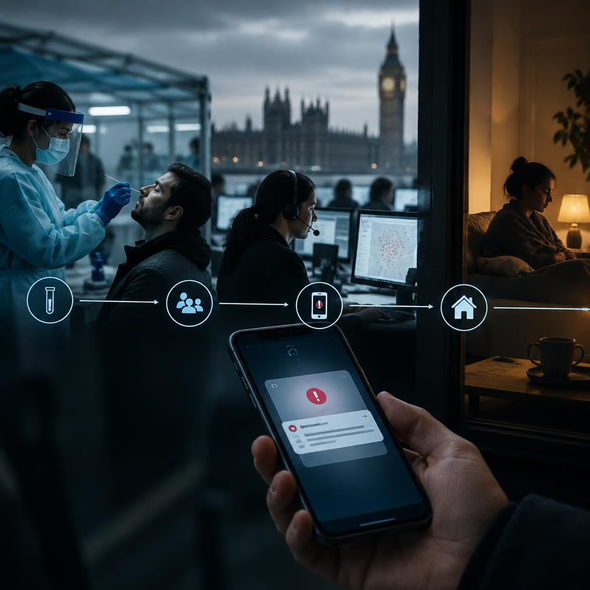
The operational question is not whether public institutions performed countable tasks, but whether those tasks connected infection detection to effective protection. A notification records one step; it cannot certify the rest.
The UK Covid inquiry found that early efforts to contain coronavirus were “doomed to fail,” the BBC reported on November 19. Its account covers testing, tracing, and the notifications associated with the “pingdemic.” The finding puts the UK’s early containment arrangements under scrutiny. It does not establish that every later intervention failed.
The mechanism matters. A test can identify an infection. Contact tracing seeks people who may have been exposed. A notification tells a contact about that possible exposure so the person can take protective action. Those are connected operations, not interchangeable achievements.
Each operation also has a clock. A result delivered after someone has exposed other people has less preventive value than an equally accurate result delivered earlier. A contact successfully reached still needs to understand the instruction and be able to follow it. Counting completed tests or delivered messages can describe workload without establishing how much transmission the system prevented.
That distinction does not make operational counts useless. Public-health managers need to know whether laboratories can process samples and whether tracing services can reach people. But a measure of one stage needs evidence about the next. Otherwise, the administrative record can declare a successful handoff while the person receiving the instruction remains unable to act.
Isolation brings the distinction into the household. Staying away from other people can require time away from work, suitable space, and help obtaining necessities. These are practical conditions for protection, not findings here about why particular people did or did not isolate. The notification cannot complete the isolation period.
The inquiry’s reported conclusion warrants scrutiny of preparedness, but it does not license an invented explanation. Nothing in the supplied BBC summary establishes that dashboards caused the failures, that officials pursued a particular numerical target, or that notification technology itself explains the outcome. The useful test is narrower: did the recorded activity describe a working route from detection to protection?
For the UK government and the Department of Health and Social Care, the next preparedness decisions should concern capacity, delivery time, and the support needed to follow instructions. Those are analytical priorities, not a substitute for the inquiry’s specific recommendations. The institutional response should state who owns each stage and how officials will test the whole sequence before an emergency requires it.
Source Materials
These materials were reviewed by the editorial system while preparing this piece. Muerte.casa may interpret, satirize, reframe, or disagree with them.
- Covid inquiry report: key findings on testing, tracing and 'the pingdemic' BBC · November 19, 2026 · Primary signal · Direct source
How did this story land?
This may be changed as you like.