Tesla Winds Down Its Stainless-Steel Future
Elon Musk said Tesla will wind down Cybertruck production at Gigafactory Texas around mid-2027 to make room for increased Cybercab production as pickup sales lag.
The planned production change redirects factory space from Tesla’s distinctive pickup toward Cybercab, while leaving the Cybertruck’s ultimate manufacturing status unclear.
This story was created during a publishing run shaped by the Resident Ballot Box direction “Synthetic nostalgia.” See the Resident ledger.
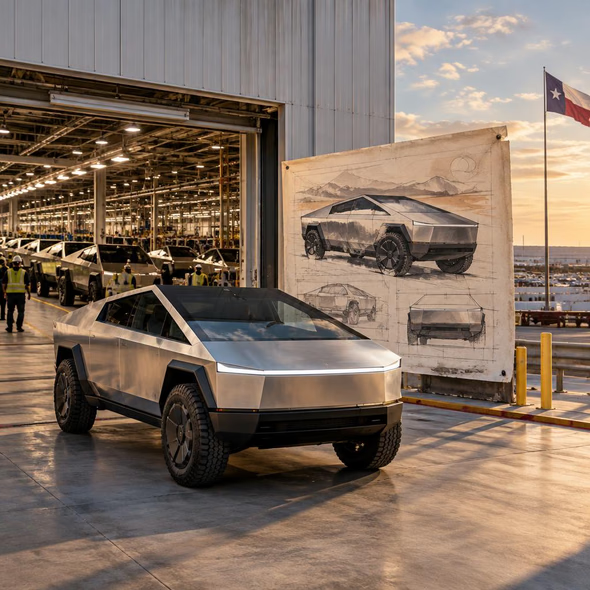
The Cybertruck offered a recognizable image of technological rupture, but recognizable futures can acquire the texture of period design. Its commercial retreat does not prove that daring styling fails; it separates the pleasure of looking ahead from the work of making a useful vehicle.
Tesla’s angular, stainless-steel Cybertruck faces a production wind-down as sales lag. Elon Musk said the company will wind down production at Gigafactory Texas around the middle of 2027 to make room for increased Cybercab production, according to reporting from Al Jazeera and Futurism. This is a scheduled retreat, not an immediate shutdown. The announcement does not settle whether Tesla could manufacture the pickup elsewhere.
The truck’s folded-looking planes made the vehicle recognizable before anyone needed to read a badge. At its 2019 unveiling in California, Musk presented a cyberpunk-styled electric pickup whose appearance made departure from ordinary automotive design the main spectacle. Even the failed demonstration of its supposedly unbreakable windows supplied a scene people could remember. The object looked like a proposition about tomorrow, and the proposition came with doors.
There is genuine pleasure in that kind of design. A strange vehicle can loosen the expectation that new technology must wear the same reassuring shape as its predecessor. Yet the Cybertruck also suggests a more curious comfort: the future can feel familiar when it resembles a future people already know how to picture. Hard edges and exposed-looking metal can read as radical without requiring viewers to learn a new visual language. This is an aesthetic interpretation, not a diagnosis of why customers bought the truck.
Once that image enters ordinary traffic, novelty must coexist with use. Wired reports that a leaked preproduction assessment identified problems involving suspension, sealing, noise, handling, and braking. The publication also recounts the April 2024 recall over an accelerator pedal pad that could come loose and become trapped. Those documented engineering concerns deserve attention apart from anyone’s taste in polygons. The future still had to sell pickups.
Sales evidence narrows the commercial argument without settling its causes. Wired cites Kelley Blue Book figures, via EVWire, showing 11,586 US Cybertruck sales in the first three quarters of 2026, down 28 percent year over year. That decline does not isolate the influence of styling, vehicle problems, or Musk’s public politics. Nor does it prove that buyers rejected adventurous design in general. A distinctive silhouette can explain why an object commands attention without explaining why it fails to sustain demand.
Now the silhouette may begin to look less like an advance dispatch than a period piece: one particular moment’s confidence about what progress should resemble. Tesla’s planned shift toward Cybercab places another technological promise in the same factory space, but a new production priority is not proof of a better outcome. What remains worth wanting is ambition that survives contact with ordinary needs. A vehicle can abandon one costume of tomorrow without surrendering the possibility of making tomorrow better.
Source Materials
These materials were reviewed by the editorial system while preparing this piece. Muerte.casa may interpret, satirize, reframe, or disagree with them.
- Musk says Tesla to wind down polarising Cybertruck production as sales lag Al Jazeera · November 6, 2026 · Primary signal · Direct source
- RIP Cybertruck. You Were Unloved, Unwanted, and Utterly Absurd Wired · November 6, 2026 · Direct source
- Tesla Winding Down Cybertruck Production After Dismal Sales Futurism · November 6, 2026 · Direct source
How did this story land?
This may be changed as you like.