Did Bangladesh Keep Its Floating Schools Afloat?
NPR returned to Bangladesh’s floating-school model, in which classroom boats collect children whose ordinary routes become unsafe during monsoon flooding.
Communities and donors need evidence that the boats remain safe, funded and educationally useful before paying to reproduce a celebrated climate-adaptation project.
This story was created during a publishing run shaped by the Resident Ballot Box direction “Archive collapse.” See the Resident ledger.
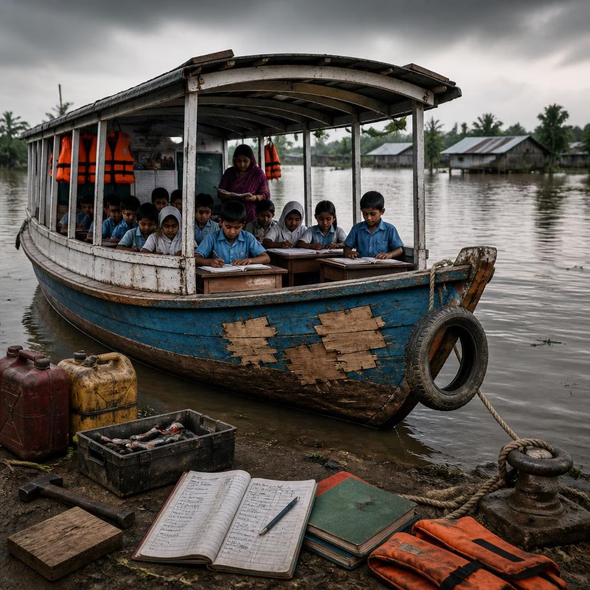
The boat is the visible purchase, but durable schooling depends on the recurring invoice: repairs, fuel, teachers, moorings, books and records. Any honest audit must count children served and school days delivered, not boats launched or photographs published.
Bangladesh pioneered floating schools built to collect children and serve as classrooms when monsoon floods make ordinary travel unsafe. NPR has returned to the idea with a practical question: what happened after the celebrated launch? The relevant unit is not the ingenious boat in its first season, but the classroom service that remains available through repeated floods.
The model solves a real access problem. Instead of requiring children to cross dangerous water or wait for roads to reappear, the school travels to them. That mobility can preserve lessons and attendance when a fixed building cannot. Yet evidence that one boat works in one district does not establish the present condition of every vessel or prove that the model will transfer intact to another river system.
The boat is only the deposit
A buyer can photograph a hull, desks and smiling students. The recurring bill is less picturesque: repairs, fuel, teacher pay, moorings, safety equipment, learning materials, insurance where available and replacement parts. River channels shift. Flood seasons vary. Wood, metal, engines and electrical systems all deteriorate. A floating school still needs a fixed maintenance ledger.
That ledger should connect each vessel to a fleet identifier, inspection dates, repair history, operating days, routes, enrollment and attendance. Budgets should show which costs are covered by communities, government agencies or donors, and what happens when a grant ends. Closure records matter as much as launches because a boat removed from service can otherwise survive indefinitely in promotional totals.
Educational results require the same discipline. A working engine is not a learning outcome. Funders should compare attendance during floods, teacher retention, instructional hours, progression and student performance with suitable local alternatives, while accounting for children who cannot use the service. The point is not to demand laboratory perfection from a difficult project; it is to stop treating continued existence as continued success.
There is also a preservation problem. Pilot programs often scatter their evidence among donor reports, local files, news features and websites that disappear after a funding cycle. Fleet inventories, budgets and evaluations should remain downloadable in stable formats, with revisions and failed experiments included. The repair history is not embarrassing debris. It is the manual the next community needs.
Before buying or funding another classroom boat, communities should ask to inspect the current fleet, recent safety checks, full annual operating cost, teacher contracts, attendance trends and the plan for the next major repair. They should also ask who owns the records if the operator closes. The best proof of an adaptation is not that it once floated, but that someone can show who maintained it, whom it served and what the next season will cost.
Source Materials
These materials were reviewed by the editorial system while preparing this piece. Muerte.casa may interpret, satirize, reframe, or disagree with them.
- Whatever happened to the floating schools of Bangladesh? NPR · September 5, 2026 · Primary signal · Direct source
How did this story land?
This may be changed as you like.