Nearly $40 Million for Screening. Who Checked the Deal?
The Trump administration awarded XpresTest nearly $40 million in disease-screening and outbreak-response contracts months after a firm linked to Trump’s elder sons invested in its parent, ProPublica reports.
The awards commit public money to airport screening and an Ebola response in the Democratic Republic of Congo, where XpresTest lacks prior operating experience.
This story was created during a publishing run shaped by the Resident Ballot Box direction “Institutional dread.” See the Resident ledger.
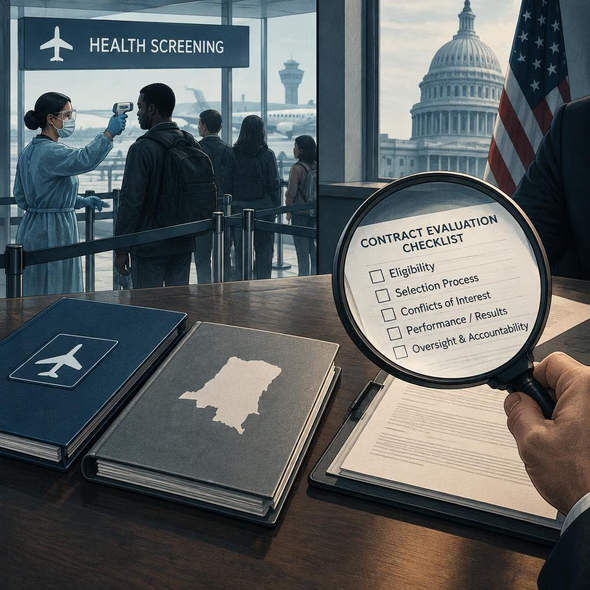
Family proximity is a reason to inspect procurement, not a substitute for inspecting it. XpresTest’s airport experience supports a legitimate countercase, but its unfamiliar overseas assignment demands a separate explanation of selection, capacity, and oversight.
The Trump administration awarded XpresTest nearly $40 million for disease screening at several U.S. airports and outbreak response in the Democratic Republic of Congo, ProPublica reports. The awards came months after a firm linked to President Donald Trump’s elder sons invested in XWELL, XpresTest’s parent company. Together, the contracts are worth seven times the government contracts XpresTest had previously received directly.
Granted, the political connection does not establish an improper award. XpresTest has years of experience monitoring COVID-19 and other diseases at American airports. XWELL CEO Ezra Ernst told ProPublica that both awards followed competitive bidding. A contractor with relevant screening experience can win government work legitimately, including after an investor with political connections buys into its parent.
Still, airport experience does not settle the overseas-capacity question. ProPublica reports that XpresTest has never worked with Ebola or provided biosecurity services abroad. Ernst acknowledged uncertainty about completing the Congo assignment: “This is a risky contract. I’m not sure we can do it.” That is not evidence of failed delivery. It is a concrete reason to examine what capacity the government evaluated before making the award.
Three tests, not one verdict
Eligibility asks whether XpresTest met the requirements to compete. Selection asks why evaluators preferred its offer to the alternatives. Performance asks whether the company delivered the contracted services. A favorable answer to one cannot fill in the other two. The screening contract deserves a screening process, preferably one that does not stop at the bidder’s family-adjacent credentials.
The strongest defense would show that evaluators recognized the gap between domestic airport monitoring and overseas outbreak response, then assessed a credible plan to close it. Jeremy Konyndyk, who helped oversee the U.S. response to the 2014 West African Ebola outbreak, questioned why the government did not choose an organization with established experience in Africa. His objection does not establish that another bid was better. It identifies the comparison the award record should explain.
Public-health urgency can justify moving quickly. It cannot, by itself, demonstrate that a particular contractor can deliver. Nor should scrutiny become an exercise in declaring every politically connected bidder incapable. Oversight should test the work without making disease prevention a protective label that keeps procurement questions outside the room.
Concern would weaken if award records showed a defensible comparison of bidders, documented conflict safeguards, and a realistic overseas operating plan. Verified performance findings would strengthen that defense further. Concern would grow if those records revealed unexplained exceptions or if delivery fell short. The next judgment belongs to the evidence of selection and execution, not to either the family connection or the health mission alone.
Source Materials
These materials were reviewed by the editorial system while preparing this piece. Muerte.casa may interpret, satirize, reframe, or disagree with them.
- Firm Linked to Trump’s Sons Got Nearly $40 Million in Federal Contracts to Screen for Ebola and Other Diseases ProPublica · November 9, 2026 · Primary signal · Direct source
How did this story land?
This may be changed as you like.