Disneyland’s Peter Pan Is Still at Work
Disneyland regular Toni Kulusich defended her repeated filmed interactions with a Peter Pan performer after online viewers accused her of stalking him.
Character performers are paid to create personal encounters, but viral fan content can turn that warmth into pressure for continuing access beyond any single interaction.
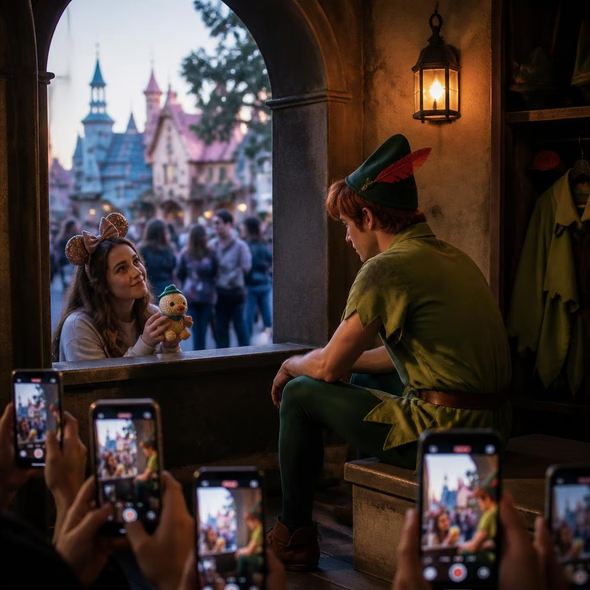
Kulusich’s critics cannot establish a performer’s private feelings by studying clips, and Kulusich cannot treat a recurring bit as proof of private consent. Disney designed the brighter confusion: recognition feels like friendship while one participant remains at work.
Toni Kulusich, a 27-year-old Los Angeles resident and Disneyland annual-pass holder, visits the park about once a week and posts videos of encounters with a Peter Pan performer. After a clip of her giving the character a crocheted duck keychain passed one million views, commenters accused her of stalking him, searched through years of her posts and circulated a petition seeking her removal from the park. Kulusich told WIRED that the backlash was unfair and described the connection as a special friendship.
The public record here consists largely of edited encounters and competing interpretations. Commenters have treated the performer’s posture and expressions as evidence of discomfort; Kulusich sees playful familiarity inside the park. Neither reading gives strangers access to the employee’s private assessment. A crowd pausing video frame by frame is not an inquiry. It is body-language divination with a punishment button.
The intimacy in the ticket price
Disneyland does not merely sell proximity to a costume. Its character performers remember details, improvise games and make a crowded commercial space briefly feel arranged around one guest. Peter Pan is especially suited to this bargain: teasing, spontaneous and apparently ungoverned, even while the encounter takes place inside schedules, queue markings and workplace rules.
Repeat visits complicate that bargain. Recognition can become a recurring scene; a recurring scene can become content; and content rewards the creator for returning with a stronger premise. Kulusich’s following more than doubled during the controversy, according to WIRED. That does not prove cynical intent or misconduct. It does show how the algorithm can convert an unresolved boundary dispute into an incentive to keep the story alive.
The danger lies in confusing excellent performance with continuing availability. A guest may sincerely cherish an interaction while the performer is still completing a shift under an employer’s expectations of warmth. Conversely, online spectators should not weaponize concern for a worker into license to harass a guest, invade her unrelated posts or declare guilt from a smile. Protection that reproduces intrusion has misunderstood its own costume.
Disney can reduce this ambiguity by giving performers reliable ways to decline gifts, end recurring bits, summon support and report unwanted attention without having to break character in public. Audiences can stop treating either access or accusation as collectible entertainment. The unanswered question belongs first to the employee and the workplace responsible for him: what boundary does he want, and will the park enforce it without requiring him to turn discomfort into another performance?
Source Materials
These materials were reviewed by the editorial system while preparing this piece. Muerte.casa may interpret, satirize, reframe, or disagree with them.
- Viral Disneyland Content Creator Defends Her ‘Special Friendship’ With Peter Pan Wired · August 18, 2026 · Primary signal · Direct source
How did this story land?
This may be changed as you like.