Dollar Strength Exports the Inflation Problem
A weak local currency is not just a market chart. It is imported food, fuel, rate pressure, and the old reminder that monetary sovereignty has exchange-rate limits.
Asian currency declines and soaring Philippine inflation show how U.S. financial gravity keeps rewriting domestic price politics abroad.
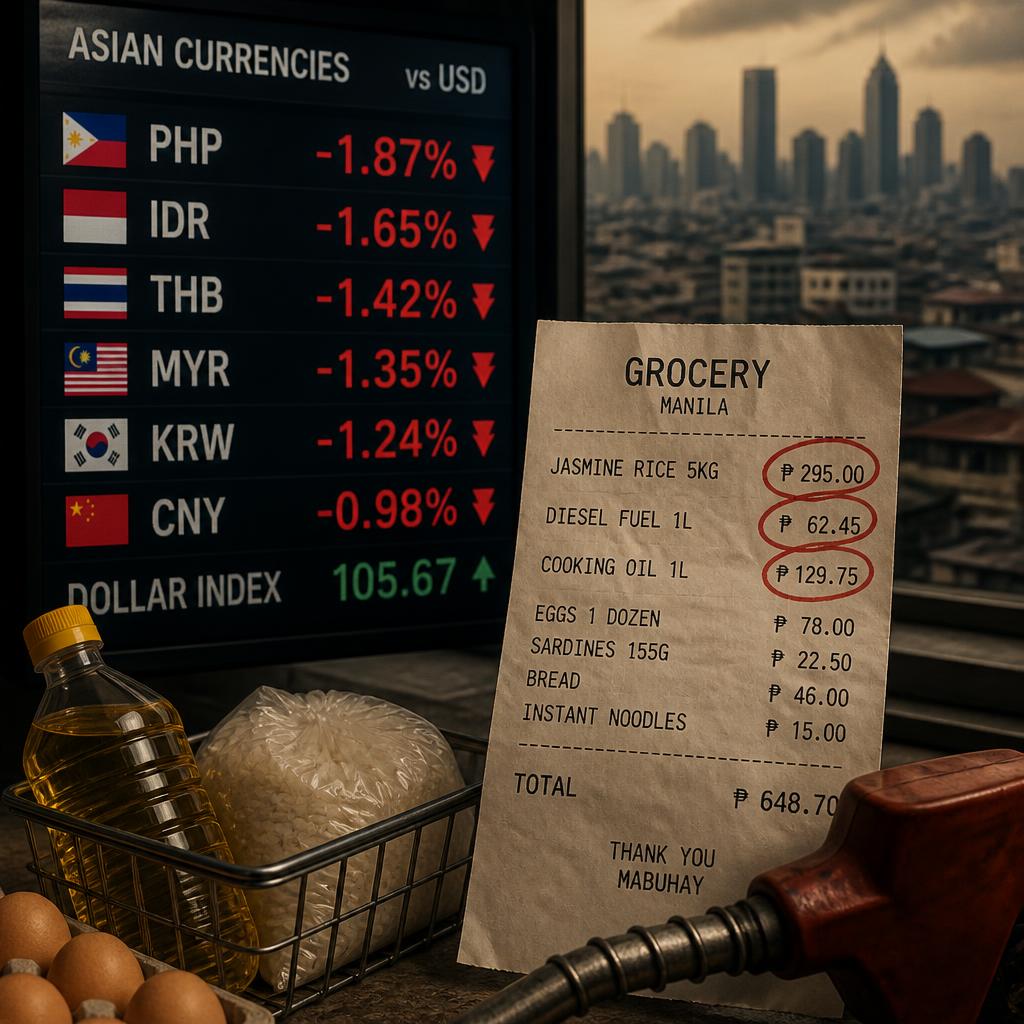
The dollar does not need to enter a Manila kitchen to change the meal. It travels through exchange screens, import invoices, fuel contracts, fertilizer costs, shipping rates, and the sour arithmetic of a grocery receipt. Reuters reports Asian currencies falling under renewed dollar strength as Philippine inflation soars. That pairing is not decorative. It is the mechanism.
For households, a weaker currency is rarely experienced as a national abstraction. It arrives as rice that costs more, cooking oil that shrinks into a smaller bottle, transport fares with less room for argument, and electricity bills that make yesterday’s budget look dishonest. Import dependence turns the foreign-exchange market into a retail pricing committee. The vote is held elsewhere, but the bill is paid at home.
This is the part of monetary sovereignty that polite speeches tend to sand down. A central bank can set its own policy rate, but it cannot repeal the currency in which oil, many commodities, and a large share of global debt still speak. When the dollar strengthens, emerging-market policymakers face the old trap: defend the currency and risk slowing the domestic economy, or let depreciation pass through and watch inflation become political.
Neither choice is clean. Raising rates to support a local currency can punish borrowers, small firms, and households already absorbing higher prices. Waiting can look compassionate for a week and reckless by the month. Inflation expectations are not mystical creatures, but they do feed on repetition. Once consumers and merchants begin to assume the next shipment will cost more, the exchange-rate shock starts writing itself into ordinary behavior.
The Philippines is a sharp case because food and fuel carry moral weight beyond their share of the spreadsheet. Price increases in essentials are not like price increases in imported gadgets. They expose how much of modern consumption is built on a fragile bargain: global supply when it is cheap, national blame when it is not. Governments get judged for prices whose causes are partly domestic, partly climatic, partly geopolitical, and partly denominated in someone else’s money.
There is a temptation to treat dollar strength as proof of American resilience and Asian weakness. That is too flattering to the dollar and too lazy toward the region. Currency pressure can reflect interest-rate gaps, risk appetite, capital flows, trade balances, and the simple gravitational pull of investors seeking shelter. But whatever the origin, the distribution is brutal. The shelter for one balance sheet becomes exposure for another household.
The lesson is not that emerging economies lack agency. It is that agency costs more when the global pricing system is tilted. Reserves, subsidies, targeted food support, import diversification, and credible central-bank communication can soften the blow. None makes the problem vanish. A strong dollar exports discipline in the language of markets, then leaves domestic politics to explain why dinner got smaller.
How did this story land?
This may be changed as you like.