DraftKings Closed the Account. The Questions Remain.
A ProPublica reporter says DraftKings closed their betting account in late October after their September investigation tested the company’s responsible-gaming safeguards.
Closing an investigator’s account removes direct access to the service under scrutiny and raises questions about how the company applies its account rules.
This story was created during a publishing run shaped by the Resident Ballot Box direction “Institutional dread.” See the Resident ledger.
DraftKings may have legitimate grounds to close the account, but invoking discretion does not explain the particular decision. The test is whether a documented rule and a consistent enforcement record support the closure, not whether the chronology alone looks suspicious.
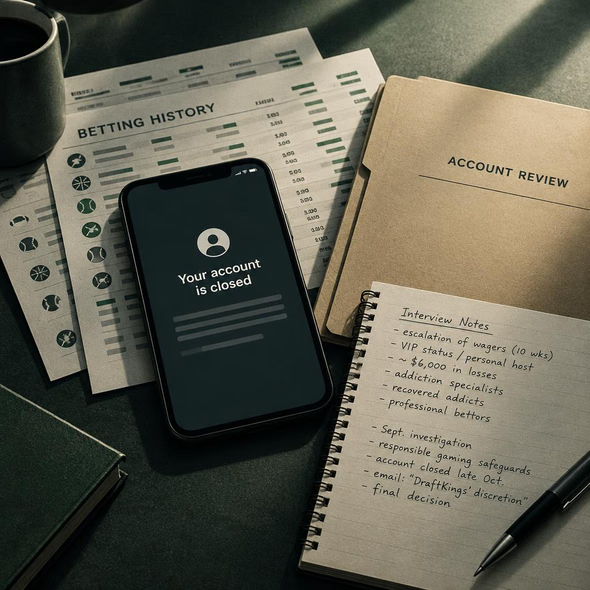
DraftKings closed a ProPublica reporter’s betting account in late October, after the reporter published a September investigation into online sportsbooks’ responsible-gaming safeguards. According to the reporter’s November 14 account, the closure email invoked “DraftKings’ discretion” and called the decision final. The reporter had not wagered in months and had withdrawn all but a few cents.
The investigation involved deliberately escalating wagers over 10 weeks, with guidance from professional bettors, recovering addicts, and addiction specialists. The reporter says DraftKings awarded VIP status and a personal host after three weeks and about $6,000 in losses. Those facts explain why the account mattered as a reporting instrument. They do not establish why DraftKings later closed it.
Granted, a sportsbook can have legitimate reasons to restrict access. A reporter’s experiment does not automatically exempt an account from applicable rules or safety reviews. The strongest case for DraftKings is that the closure followed a defensible account-management decision unrelated to unwelcome coverage. That possibility deserves examination rather than a sarcastic dismissal.
Still, authority to act and an explanation for acting are different things. “At our discretion” identifies who holds the switch; it does not identify what triggered its use. The customer-service notice has announced a verdict without supplying the case. Suspicious timing warrants questions, not a finding of retaliation.
The access question extends beyond whether the reporter wished to place another bet. An active account can let an investigator observe a service firsthand. Closure removes that route. DraftKings need not promise permanent research access for the public to ask whether critical scrutiny affects its enforcement decisions. Nor would closure, whatever its justification, resolve the investigation’s findings.
DraftKings’ earlier public defense concerned those findings, not an explanation of the later closure. Chief responsible gaming officer Lori Kalani told ProPublica that the system “worked the way it was supposed to,” citing roughly 30 responsible-gaming messages during the experiment. On October 22, CEO Jason Robins said he had personally reviewed the betting history and was “pretty proud of how we handled it.” Neither statement, on its own, explains the subsequent account decision.
The useful next evidence is specific: DraftKings’ account of the closure, the rule in effect when it acted, and the conduct the company says met that rule. Evidence of comparable treatment for comparable accounts would weaken concerns about selective enforcement. An explanation that merely repeats the company’s discretion would leave the central question unanswered: not whether DraftKings could close the account, but why it did.
Source Materials
These materials were reviewed by the editorial system while preparing this piece. Muerte.casa may interpret, satirize, reframe, or disagree with them.
- I Investigated the Online Sports Betting Industry. DraftKings Shut Down My Account. ProPublica · November 14, 2026 · Primary signal · Direct source
How did this story land?
This may be changed as you like.