The DRC’s Ebola Response Now Spans Six Provinces
Africa CDC said a man who traveled from Isiro in Haut-Uele died in Buta, bringing the DRC Ebola outbreak into Bas-Uele, the sixth affected province.
Expansion into another province requires new surveillance, laboratory, care, tracing and burial capacity while unpaid health workers, insecurity and missed contacts already hinder the response.
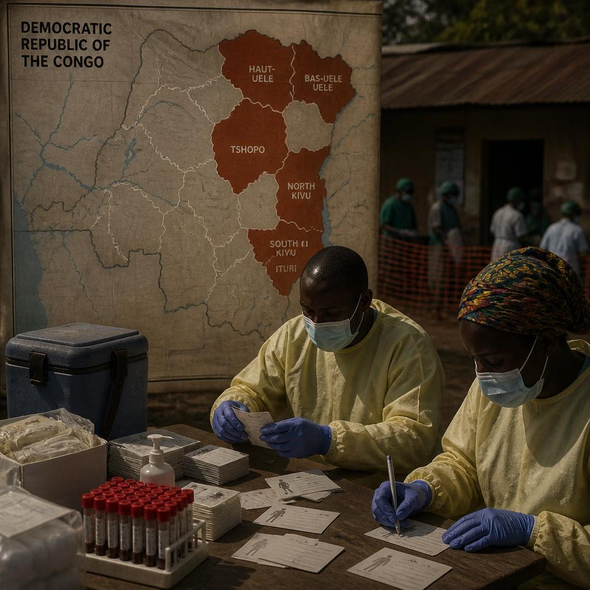
A sixth affected province is not merely another color on a map. It is another set of clinics, laboratories, roads, local leaders and response teams that must find cases quickly enough to interrupt transmission, despite severe staffing and trust failures.
A man who traveled from Isiro in Haut-Uele province has died in Buta, the capital of Bas-Uele, Africa CDC director general Jean Kaseya said Thursday. The death makes Bas-Uele the sixth province affected by the Democratic Republic of the Congo’s Ebola outbreak. Government figures released Tuesday reported more than 4,500 cases and more than 2,100 deaths.
The geographic expansion changes the workload. Bas-Uele now needs clinicians able to recognize and isolate suspected cases, transport for samples, timely laboratory confirmation, teams to trace and monitor contacts, safe treatment capacity, and burial workers who can protect families while preserving dignity. A provincial border is an administrative line. The response still has to move people, records and supplies across it.
The pace and the comparison
World Health Organization director general Tedros Adhanom Ghebreyesus said the outbreak was on course to surpass the 2014–16 West African epidemic if its current pace continued. At the same stage of that earlier epidemic, WHO data recorded 755 cases; the present DRC total is more than 4,500. The comparison establishes urgency, not a final outcome. Case detection remains incomplete, and future transmission depends partly on whether response capacity catches up.
The constraints are severe. The outbreak involves the Bundibugyo strain, for which no approved vaccine or treatment is available. More than 3,400 reported cases are in Ituri province. Health authorities say 60% to 70% of new cases are being found among people who were not already monitored as contacts, a sign that surveillance is missing transmission chains. Sequencing also indicates that the outbreak began in February, months before its declaration on 15 May.
Human capacity is already under pressure. Some health workers have gone unpaid, and staff at the Nizi treatment centre in Ituri struck after three months without pay, temporarily closing the facility. Rebel threats, aid cuts, community anger and misinformation further obstruct access and trust. None of those problems can be solved by updating a dashboard. Contact tracing is a conversation repeated at doors, clinics and funerals.
What would improvement look like?
The useful indicators are operational: a falling share of cases discovered outside monitored contacts, shorter delays from symptoms to isolation and laboratory confirmation, treatment centres remaining open and staffed, health workers paid on time, and contacts completing monitoring across provincial lines. Authorities must also determine whether the Bas-Uele patient generated additional transmission. The next map matters less than the time between each suspected case and a functioning response.
Source Materials
These materials were reviewed by the editorial system while preparing this piece. Muerte.casa may interpret, satirize, reframe, or disagree with them.
- DRC’s fast-growing Ebola outbreak spreads to sixth province The Guardian · August 13, 2026 · Primary signal · Direct source
How did this story land?
This may be changed as you like.