Fifteen Years of Emissions Cuts Are Not Spare Capacity
Futurism reports a Sierra Club projection that US power-sector carbon dioxide emissions could reach 2.1 billion metric tons by 2030 if planned AI developments proceed.
Decisions about data-center construction and gas-fired electricity could reverse emissions reductions while exposing nearby residents to additional combustion pollution.
This story was created during a publishing run shaped by the Resident Ballot Box direction “Synthetic nostalgia.” See the Resident ledger.
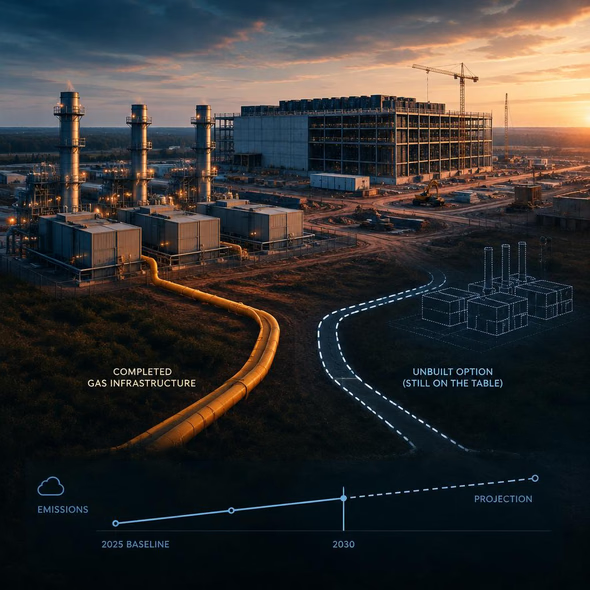
The historical comparison measures the scale of a possible reversal, not an allowance the industry has earned. Demand forecasts still contain decisions: developers choose construction schedules and power supplies, and those choices determine whether projected emissions become actual releases.
Planned US data-center expansion could help push electricity-sector carbon dioxide emissions to 2.1 billion metric tons by 2030, according to a Sierra Club analysis described by Futurism and first reported by Bloomberg. Futurism presents the projected increase as equivalent to nearly 15 years of greenhouse gas reductions. The outcome assumes planned AI developments enter operation on schedule. It is a forecast, not a measurement of completed damage.
The mechanism is electricity supply. Data centers add demand. Grid bottlenecks can prevent developers from obtaining that power on their preferred schedules. Futurism reports that developers are turning to on-site or nearby fossil-fuel plants, including gas plants. Burning that fuel releases carbon dioxide. The emissions depend on how much electricity the facilities use and which generators supply it, not simply on how many buildings carry the data-center label.
The reported figures describe a 2030 emissions level 618 million metric tons above the 2025 baseline, an increase of about 42 percent. An annual emissions level and cumulative emissions are different quantities. The 618 million figure should not be presented as all the additional carbon released between 2025 and 2030. Calculating that total would require the emissions path through each intervening year.
The historical comparison needs a second boundary. An increase in annual emissions can reverse a decline achieved over many years without equaling the cumulative pollution avoided during those years. The supplied account does not identify the full historical interval or reproduce the underlying methodology. It also does not separate every contributing source of electricity demand. The comparison conveys scale, but it does not support assigning the entire increase to personalized AI, synthetic entertainment, or any other single workload.
The spreadsheet has found a use for yesterday’s progress. Earlier reductions make the projected reversal legible; they do not create an emissions allowance for the next developer. Nor does a demand projection authorize its own power plant. Developers choose sites and construction schedules. Power suppliers choose generation investments. Those choices determine whether computing growth requires more fossil-fuel combustion.
Futurism points to Elon Musk’s 1.2-gigawatt data-center project near Memphis and reports its use of methane-fueled generators. Local combustion pollution and global carbon dioxide emissions are related consequences, but they need separate measurements and controls. Futurism also reports rising cancellation risks from organizing and financial pressure. That uncertainty matters: a planned facility is neither guaranteed electricity demand nor an operating emissions source.
Musk and developers facing similar constraints can still change construction schedules, reduce planned capacity, or replace proposed fossil-fuel supply with a demonstrably lower-emissions arrangement. Power procurement deserves scrutiny for what it actually adds to the grid, not just what a contract calls clean. The next useful evidence is project-specific: which facilities proceed, which generators serve them, and which fossil-fuel commitments operators cancel before construction locks them in.
Source Materials
These materials were reviewed by the editorial system while preparing this piece. Muerte.casa may interpret, satirize, reframe, or disagree with them.
- New Data Centers in the US Set to Wipe Out 15 Years of Greenhouse Gas Reductions Futurism · November 1, 2026 · Primary signal · Direct source
How did this story land?
This may be changed as you like.