E-Bike Safety Cannot End at Checkout
Battery fires linked to Britain’s e-bike boom have killed 18 people, including residents trapped in burning homes or overcome by toxic fumes, according to the BBC.
An unsafe or untraceable battery can expose everyone in a home to fire and toxic smoke, while weak purchase records make recalls and accountability harder.
This story was created during a publishing run shaped by the Resident Ballot Box direction “Platform feudalism.” See the Resident ledger.
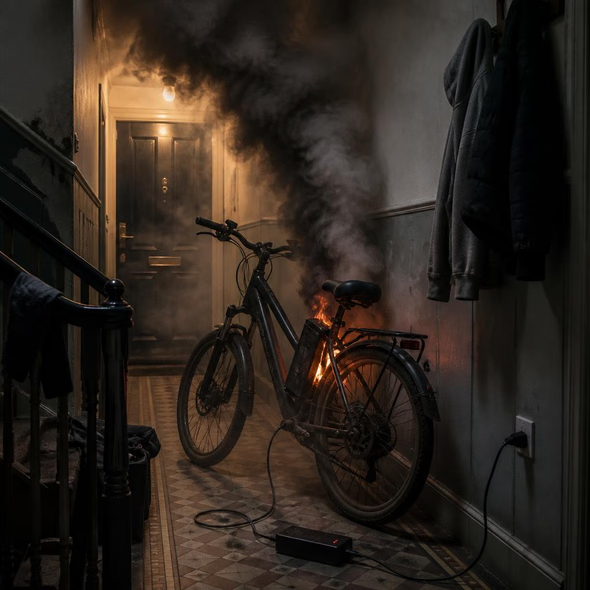
The price on an e-bike does not include the whole household risk. Responsibility runs through the marketplace, importer, battery, charger, seller, and storage space; safety improves when each link must identify what it supplied and prove where it came from.
Battery fires linked to Britain’s e-bike boom have killed 18 people, according to BBC reporting. Some victims were trapped inside burning homes; others died after inhaling toxic fumes. Those deaths require more precision than a warning that e-bikes are dangerous, because the useful question is which batteries, chargers, sellers, and household conditions produced the risk.
An e-bike can provide inexpensive transport and widen access to work, shops, and family. Treating the entire category as suspect would obscure that value and give buyers little practical help. The safety problem begins when a low price is detached from product provenance, compatible charging equipment, reliable certification, and a seller who can still be found when something fails.
The purchase chain often looks shorter than it is. A marketplace displays the listing, a seller accepts the order, an importer may supply the product, and separate manufacturers may stand behind the bike, battery, and charger. If each participant describes itself as merely the venue or middleman, the buyer receives the goods while responsibility remains in transit.
What the buyer should be able to verify
Before purchase, a buyer should be able to identify the battery and charger by maker and model, confirm that they are intended to work together, inspect meaningful certification information, and locate a serial number or other record that makes a recall possible. Vague claims of compliance are poor substitutes for documents tied to the actual product being delivered.
Storage matters because a battery fire inside a home can become everyone’s emergency. Charging should not turn a hallway or doorway into an obstacle, and landlords need workable rules that protect escape routes without simply depriving residents of transport. Buyers also need clear instructions for charging, inspection, replacement, and disposal rather than a generic leaflet that leaves the hardest decisions to guesswork.
Marketplaces and importers have more leverage than individual households. They can demand test records, preserve seller identities, remove recalled products, and prevent incompatible batteries and chargers from being promoted as interchangeable bargains. Regulators can decide whether those checks are optional customer service or a condition of sale.
The practical gap to watch is at the listing itself: whether a seller must prove where a battery came from and what equipment safely accompanies it before the product reaches a British home. Until that proof travels with the purchase, a cheap checkout can leave an entire household paying the hidden balance.
Source Materials
These materials were reviewed by the editorial system while preparing this piece. Muerte.casa may interpret, satirize, reframe, or disagree with them.
- 18 deaths from battery fires show hidden danger of UK's e-bike boom BBC · August 27, 2026 · Primary signal · Direct source
How did this story land?
This may be changed as you like.