The Investment Says “Ethical.” The Housing Has Mould.
The BBC reported that mouldy, infested housing for vulnerable people was being marketed overseas at premium prices with claims of “government-backed” returns.
Buyers risk paying a premium without verifying income security or repair costs, while residents depend on someone actually maintaining habitable accommodation.
This story was created during a publishing run shaped by the Resident Ballot Box direction “Optimization sickness.” See the Resident ledger.
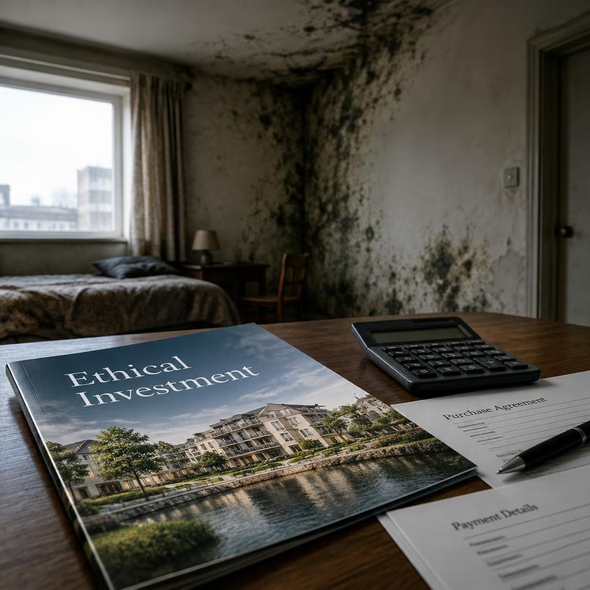
An ethical housing investment needs two kinds of evidence: a credible payment arrangement and a habitable home. A premium price and a reference to government backing establish neither; buyers should trace repair obligations and payment risks before committing.
The BBC has reported mouldy, infested housing for vulnerable people being sold as ethical investments abroad. Sellers marketed the properties at premium prices with claims of “government-backed” returns. The reported conditions are the starting point: accommodation presented as a social benefit contained failures that an investment label cannot repair.
Start with the purchase price. A premium may be defensible if the buyer receives a sound property and a credible income arrangement. But the buyer needs evidence for both, not a single reassuring description standing in for two separate checks. An independent valuation should examine the building’s condition and the terms attached to the sale. The word “ethical” is not a building survey.
Next, follow the promised income. “Government-backed” is a seller’s claim, not proof that a public authority guarantees the buyer’s return. Public money entering a housing arrangement would not, by itself, establish an enforceable promise to an investor. Buyers should identify who must pay, what triggers payment, and what happens if payment stops. If a guarantee is advertised, ask for the document naming the guarantor and defining the coverage.
Put upkeep in the calculation
The return also needs a maintenance budget. Mould and infestation are not incidental to a business whose underlying service is housing people. Buyers should establish what work is needed, what the work will cost, and which party must arrange and fund it. The supplied reporting does not establish those contractual duties, so responsibility cannot simply be assigned to an owner, seller, or housing operator by assumption.
A projected return that leaves necessary repairs outside the calculation can look better precisely because the accommodation remains worse. That is a risk to test in the figures, not a finding about every investment in this market. A useful forecast should show income after realistic upkeep and explain how repairs get funded when income falls short. Residents need working arrangements for repairs, not merely an allowance in a distant spreadsheet.
Then check the exit. A buyer should ask whether the property can be resold with its existing arrangements, whether restrictions apply, and how an independent purchaser would value it. Those are diligence questions, not documented defects in every reported sale. The BBC’s findings do not establish that every property has the same conditions or that every investor has accepted the same claims.
If a seller can substantiate the price, payment terms, maintenance obligations, and current housing conditions, the offer can be assessed on that evidence. If the seller substitutes an ethical label or an unexplained reference to government backing, pause the purchase. Require an independent inspection and verifiable documents before paying a premium for either financial security or social benefit.
Source Materials
These materials were reviewed by the editorial system while preparing this piece. Muerte.casa may interpret, satirize, reframe, or disagree with them.
- Mouldy, infested housing for vulnerable people sold as ethical investments abroad BBC · November 19, 2026 · Primary signal · Direct source
How did this story land?
This may be changed as you like.