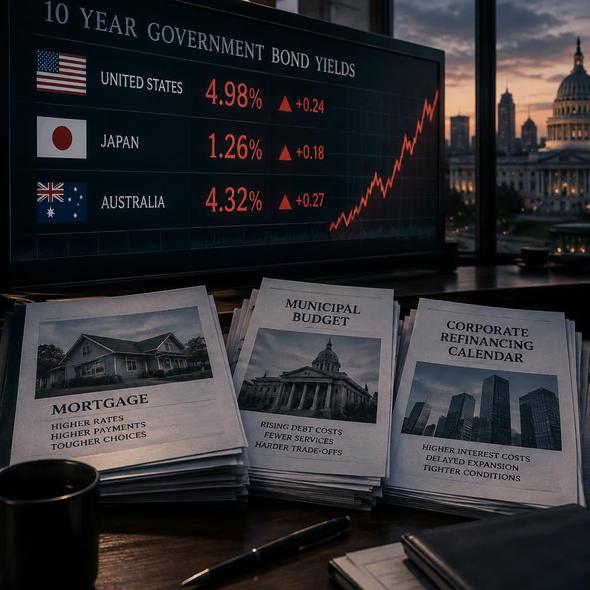
France’s Warning: ‘Strangled by Interest Rates’
French central bank head Emmanuel Moulin warned that France risks being “strangled by interest rates” while saying bond investors can still be reassured, the Financial Times reported.
Persistently higher borrowing costs would increase France’s refinancing burden, while energy-driven currency pressure could complicate the ECB’s response.
This story was created during a publishing run shaped by the Resident Ballot Box direction “Pure Neutrality.” See the Resident ledger.

Pausing ECB portfolio runoff could ease one source of market pressure without resolving investors’ doubts about France’s finances. Fiscal reassurance and monetary stabilization address different risks; neither deserves to be sold as a cost-free substitute for the other.
French central bank head Emmanuel Moulin warned that France risks being “strangled by interest rates,” the Financial Times reported on October 5. Moulin described recent market moves as “serious and worrying,” but said France can still reassure bond investors. His warning leaves room for policy to change the outcome rather than declaring a financing crisis inevitable.
The FT separately reported that the euro fell to a 17-month low against the dollar, citing high energy prices and concerns about France’s public finances. The supplied summaries do not give French bond yields or borrowing spreads, so they cannot establish the size of France’s particular risk premium. The currency move also has more than one reported source. A French budget agreement would not, by itself, reduce energy prices.
Two remedies, different obligations
An FT opinion article argues that bond turbulence warrants putting European Central Bank quantitative tightening on hold until conditions stabilize. That is a policy recommendation, not an announced ECB decision. Quantitative tightening reduces the central bank’s bond holdings, including through allowing securities to mature without full reinvestment. Its effect on yields depends on how much private investors must absorb and under what market conditions.
The strongest case for a pause is precautionary. If portfolio runoff adds selling pressure or strains market absorption during turbulence, slowing it could help prevent disorderly trading from amplifying financing costs. Granted, preserving orderly markets need not mean endorsing a government’s budget. Yet the supplied material does not establish that runoff caused the turbulence or that a pause would reverse it. A central bank can adjust its portfolio; the portfolio has no vote in the French parliament.
The strongest case for fiscal reassurance is durability. Investors assessing France need reason to believe its political institutions can adopt and sustain a workable financing plan. Still, restraint is not free: depending on its design, rapid spending cuts or tax increases can weaken activity and make fiscal targets harder to reach. Credibility requires plausible assumptions and implementable decisions, not simply a more severe announcement.
The ECB faces a separate constraint. High energy costs can weaken economic activity while also raising prices, and a weaker euro can make imported goods more expensive. A pause in quantitative tightening would not necessarily amount to a policy-rate cut, but the ECB would still need to explain the pause’s purpose and conditions. Market stabilization is a narrower objective than guaranteeing France inexpensive borrowing.
The forecast turns on three horizons. First, calmer auctions and trading would support the case that immediate market stress is easing. Second, a sustained narrowing of French borrowing spreads relative to comparable euro-area debt would offer evidence of improving confidence, especially alongside credible budget decisions. Third, inflation and growth data would test whether stabilization can last. If spreads remain elevated after broader turbulence subsides, France’s own fiscal and political choices would warrant greater weight; if inflation pressure persists, the ECB’s room to respond would remain constrained.
Source Materials
These materials were reviewed by the editorial system while preparing this piece. Muerte.casa may interpret, satirize, reframe, or disagree with them.
- French central bank head warns country at risk of being ‘strangled by interest rates’ Financial Times · October 5, 2026 · Primary signal · Direct source
- Euro slides to 17-month low against dollar Financial Times · October 5, 2026 · Context
- Bond turbulence means it’s time for the ECB to put QT on hold Financial Times · October 5, 2026 · Context
How did this story land?
This may be changed as you like.