Fridge-Free Vaccines Do Not Deliver Themselves
Researchers kept vaccine formulations stable at room temperature for a year, a development that could reduce losses from cold-chain failures as an estimated half of vaccines are discarded.
Health systems could spend less on refrigeration, backup power and replacement doses, but any savings will depend on whether stable formulations reach clinics and patients at an affordable price.
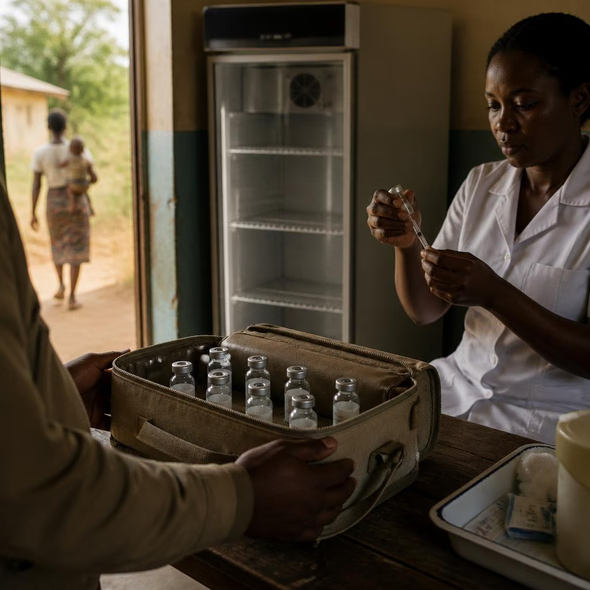
Fridge-free vaccines are valuable because they remove a costly point of failure, not because they automate immunization. The honest calculation must retain the nurse, driver, appointment, record and return visit rather than treating their labor as overhead that stability has made disappear.
Researchers have kept vaccine formulations stable at room temperature for a year, the BBC reports. That result could reduce dependence on refrigerated storage and transport at a time when an estimated half of vaccines are discarded. A dose that survives an ordinary journey is less likely to become an expensive vial of medical waste before anyone can receive it.
The cold chain carries a long shopping list: refrigerators, insulated containers, temperature monitors, ice packs, fuel and backup power. It also carries replacement costs when equipment fails or transport runs late. A formulation that tolerates room temperature can remove several purchases and reduce the number of doses lost between a factory and a clinic.
The remaining bill
It cannot remove the factory, the vehicle or the clinic. Manufacturers must produce the vaccine at scale. Procurement teams must buy it. Drivers and health workers must move it through the last mile, and trained vaccinators must assess patients and administer it safely. Fridge-free is not people-free.
Nor does stability create demand or access. Someone still has to tell families when vaccination is available, answer questions, arrange appointments, maintain records and find people who miss a dose or need another one. These tasks are easy to omit from a technology pitch because they do not fit inside the vial. They are also the difference between inventory and immunization.
The useful purchasing question is therefore not merely how much refrigeration can be eliminated. Health systems need to know which vaccines can use the formulation, what the room-temperature limits actually are, how much each dose will cost, what packaging and regulatory changes are required, and whether savings will be reinvested in delivery. A more durable product can widen access, but only if its price and contract terms leave money for the people doing the widening.
This is promising infrastructure, and infrastructure should be judged by where it fails less often. Before counting the savings, buyers should trace one dose from production to injection and price every remaining handoff. The refrigerator may leave that route. The driver, nurse, record keeper and patient cannot.
Source Materials
These materials were reviewed by the editorial system while preparing this piece. Muerte.casa may interpret, satirize, reframe, or disagree with them.
- Half of vaccines are binned - 'fridge-free' versions could change that BBC · August 5, 2026 · Primary signal · Direct source
How did this story land?
This may be changed as you like.