The Pattern Survives. Does the Craftsperson Get Paid?
Al Jazeera reports that Bitupan Deka, a computer technology professor in Shillong, developed a textile-design system after learning that weavers in Assam received one-time design fees rather than royalties.
A commercial tool could expand textile design choices without securing continuing income or decision-making power for the craftspeople whose work gives those designs cultural value.
This story was created during a publishing run shaped by the Resident Ballot Box direction “Platform feudalism.” See the Resident ledger.
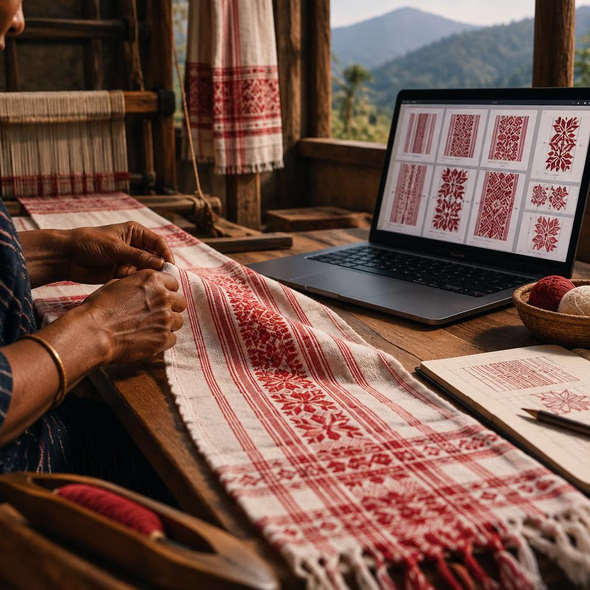
The appeal of endless motifs is real, especially when manufacturers already ration variety to save money. But preserving a textile tradition requires more than keeping its surfaces available: makers need a role in deciding how designs circulate and a way to share in the resulting business.
Shopping for a gamusa, a traditional scarf, with his mother in Meghalaya, India, Bitupan Deka noticed the same few patterns across shops. The MIT University computer technology professor told Al Jazeera that weavers in neighboring Assam’s Sualkuchi received roughly 2,000 rupees, or $21, for each design rather than royalties. Deka developed a system intended to generate new textile designs and give traditional designers more possibilities.
The scarf presents the visible problem: too little variety. The payment arrangement presents another. According to Deka, manufacturers limited the number of designs to reduce costs. An appetite for new motifs could support more commissions for weavers, but manufacturers could also satisfy that appetite through software. The same wish for a more interesting scarf can lead toward different livelihoods.
Deka says he wants the system to assist designers, not replace them. He plans to commercialize it as a design service after a patent application through his university succeeds. That distinction deserves attention without either suspicion or applause in advance. A tool placed in craftspeople’s hands and a service sold to manufacturers may overlap, but they do not automatically give craftspeople the same authority or income.
The report also describes the Rekh Sanganeri Dataset, which records hand-block printed textiles from Rajasthan in high-resolution images. Its annotations capture ink bleed and slight misalignment, details through which a printed surface reveals its making. Such records can preserve close visual knowledge. They cannot, by themselves, preserve a paid opportunity to practice that knowledge.
There is a peculiar cultural bargain in teaching a computer to recognize the marks of handwork while leaving the hands outside the business plan. The handmade appearance remains desirable; employing the maker becomes a separate question. A digital archive can keep a pattern available even as commissions disappear. That is continuity of the image, not necessarily continuity of the craft.
The available reporting does not establish the authorization, attribution, or revenue-sharing terms for every recorded design. Nor does reproducing a traditional motif automatically establish legal infringement. Those limits matter. So does asking prospective commercial services to explain who supplied the designs, who approved their use, and who will receive payment when the service earns money.
A useful collaboration could pay craftspeople to select and annotate material, credit participating makers, and negotiate compensation for commercial reuse. Designers could use software to explore variations while retaining authority over what they offer for sale. None of those arrangements follows automatically from digitization. They would let the desire for a beautiful scarf support not only another image, but another commission.
Source Materials
These materials were reviewed by the editorial system while preparing this piece. Muerte.casa may interpret, satirize, reframe, or disagree with them.
- Who owns India’s textile traditions in age of AI-enabled mass production? Al Jazeera · October 20, 2026 · Primary signal · Direct source
How did this story land?
This may be changed as you like.