“Minimal Signs” of Lead Is an Early Finding
The US Army detonated nearly five tons of degraded lead azide outside Middletown, Iowa, on Wednesday; Wired reports reassuring early monitoring while more rigorous testing remains pending.
Residents need to know which places and environmental media the early findings cover before using those results to judge possible exposure or changes to precautions.
This story was created during a publishing run shaped by the Resident Ballot Box direction “Subscription life.” See the Resident ledger.
Reassuring preliminary measurements deserve credit, not promotion into a complete environmental assessment. The Army and EPA can reduce uncertainty by publishing the scope of the early monitoring, the remaining tests, and the decisions those results will guide.
The US Army detonated nearly five tons of degraded lead azide outside Middletown, Iowa, on Wednesday morning. Wired reports minimal early signs of environmental lead. EPA chief Lee Zeldin told CNN that preliminary monitoring detected no lead in the air around the site. More rigorous testing will take days. The early result is reassuring, but its scope matters.
The Army had deemed the aging explosive too unstable to move and remediate, according to Wired. NPR’s account describes evacuation preparations ahead of the operation. Those preparations addressed possible harm; they did not measure contamination. Neither the precautions nor the sound of the explosion can establish how much lead reached surrounding communities.
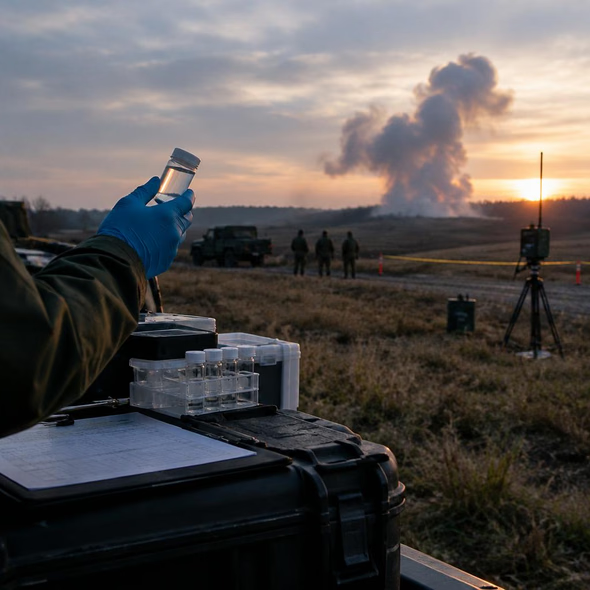
Air, soil, and water sampling will help determine whether exposure occurred and how far any contamination extends. An early air finding cannot answer every soil or water question. Officials should identify the monitoring locations, collection times, methods, and detection limits behind the preliminary statement. “No lead detected” needs those boundaries to remain useful.
University teams provide another source of evidence. Wired reports that University of Iowa departments began setting up air and soil monitoring stations late last week. Purdue University researchers requested soil samples from Middletown. University of Iowa environmental health professor Peter Thorne describes the university’s work as a supplement to federal monitoring, not a replacement. Agreement between comparable assessments could strengthen confidence.
Comparability requires explanation. Results from different locations, collection periods, or methods may answer different questions. If findings diverge, the Army, EPA, and university researchers should explain those differences before residents have to reconcile competing summaries themselves. A press statement is not a sampling protocol.
That obligation follows a documented communication failure. Wired reports that some towns received little information beyond notices about planned soil sampling before the Army issued a press release days ahead of the originally planned explosion. Better communication now means explaining what each result supports, what remains unresolved, and whether any finding changes public guidance. Uncertainty does not require silence or an all-clear.
The next substantive findings are expected over the coming days, not on a precise schedule established by the available reporting. The Army and EPA can publish an update timetable now. They can also identify who analyzes each sample set, release results with their limitations, and state which findings would trigger further sampling or revised precautions. Completing the detonation leaves those decisions available.
Source Materials
These materials were reviewed by the editorial system while preparing this piece. Muerte.casa may interpret, satirize, reframe, or disagree with them.
- The Iowa Lead Detonation Happened. Now the Real Work Begins to Study It Wired · November 25, 2026 · Primary signal · Direct source
- Army to detonate tons of lead azide after delays. And, Abrego Garcia leaves U.S. NPR · November 25, 2026 · Direct source
How did this story land?
This may be changed as you like.