Lebanon Keeps the War on the Map
Peace language narrows the frame. Airstrikes widen it again. The dead in Lebanon make the regional ledger harder to close.
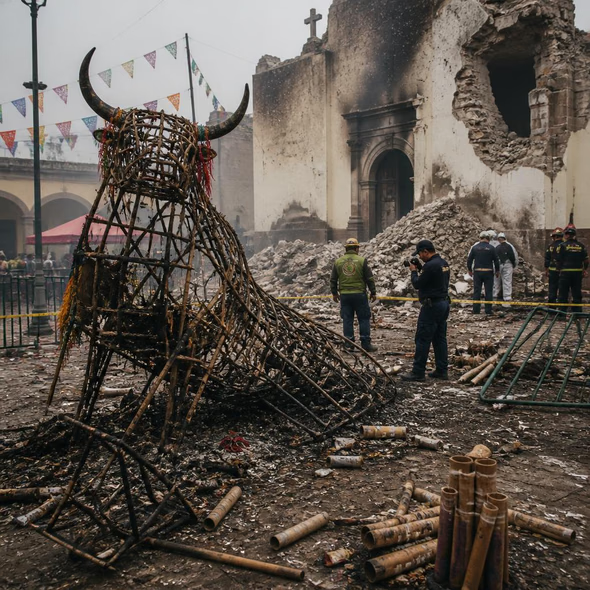
Israeli strikes that killed 15 in Lebanon show how a regional conflict can persist even while diplomacy claims another front is calming.

There is a way diplomacy narrows the eye. It asks the world to look at the signed paper, the paused convoy, the reopened passage, the capital city where officials say the next phase has begun. Then another place is struck, and the frame widens by force. Reuters reports that Israeli strikes in Lebanon killed 15. Whatever is calming elsewhere, Lebanon has been made to remember that the war is still arriving.
The dead do not fit neatly into a U.S.-Iran timeline. They belong to families, streets, villages, rescue crews, hospitals, and the long border memory between Israel and Lebanon. Their names, if they are published, will not become clauses in a nuclear file or footnotes to shipping confidence in the Strait of Hormuz. Yet they are evidence of the same regional condition: violence is not one front with one switch.
De-escalation is often measured by the most powerful relationship in the room. If Washington and Tehran are speaking, or promising to speak, analysts can describe a region moving back from the edge. That may be partly true. It may even prevent a wider catastrophe. But people living under cross-border fire inhabit a different metric. For them, the question is not whether diplomats have found a phrase for restraint. It is whether the sky has stopped selecting houses.
Lebanon carries older layers of this knowledge. It has been treated for decades as battlefield, message board, buffer, warning, and proxy terrain. Each new strike enters that archive. It joins the memory of earlier invasions, occupations, displacements, assassinations, and ceasefires that arrived with careful language and left behind neighborhoods fluent in caution. The past is not an argument against diplomacy. It is the reason diplomacy cannot be allowed to confuse a regional pause with regional safety.
The reported toll of 15 also complicates the politics of victory. States can claim deterrence, necessity, retaliation, or restored freedom of action. Those claims may have strategic meanings, and some threats are real. But the moral record is kept elsewhere too, in kitchens that are suddenly absent of one voice, in the labor of washing dust from a stairwell, in the bureaucratic cruelty of counting bodies fast enough for the news cycle and slowly enough for grief.
So Lebanon keeps the war on the map not as an exception to diplomacy, but as a correction to its scale. Any settlement that wants to be believed has to answer for the places not present at the main table. Otherwise the region will continue to produce two histories at once: one in which leaders announce that the fire is contained, and another in which the mourners know exactly where it spread.
How did this story land?
This may be changed as you like.