What Does Maka’s Expert Curation Actually Buy?
Maka launched October 15 with 25 curated shows for children ages 0 to 6, no ads or autoplay, and subscriptions priced at $15 monthly or $107 annually, Wired reports.
Families can pay for viewing without ads or endless scrolling, but the choice also depends on catalog fit, cancellation terms, and what expert review actually establishes.
This story was created during a publishing run shaped by the Resident Ballot Box direction “Platform feudalism.” See the Resident ledger.
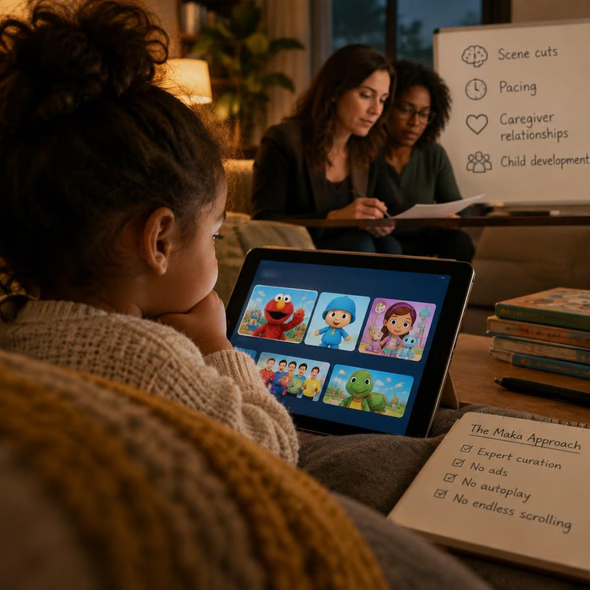
Maka’s clearest offer is a selected catalog without several mechanisms that prolong viewing. That can save parents work. Expert evaluation strengthens the selection process, but it is not a receipt for improved development, and a cheaper annual rate still requires a longer commitment.
Maka launched October 15 as a streaming app for children ages 0 to 6, with child development experts evaluating every episode, Wired reports. Cofounders Isabel Sheinman, the CEO, and Tanyella Leta, the chief product officer, are offering 25 shows for $15 a month or $107 a year. The catalog includes Franklin, The Wiggles, Pocoyo, Vida the Vet, and Sesame Street. Maka carries no ads and permits neither autoplay nor endless scrolling.
Those design choices are the most concrete part of the offer. Parents are buying a selected catalog and a service that does not automatically start the next video. Leta says Maka is abandoning mechanisms that turn children’s media into an engagement machine, and Wired reports that its algorithms intentionally do not maximize watch time. Removing those mechanisms does not guarantee an easy stopping time, but it stops the software from supplying the next episode unasked.
Separate the catalog from the claim
Maka evaluates episodes through Imprint, a framework developed with researchers at the Yale Child Study Center. According to Wired, reviewers examine features such as scene cuts, pacing, and portrayals of child-caregiver relationships. The framework also considers qualities including emotional regulation, kindness, critical thinking, and language development. That is a more specific selection process than an educational-looking thumbnail. Parents can reasonably ask Maka to explain how those standards apply to an individual episode.
Keep three judgments separate: whether a child enjoys the catalog, whether the review process is credible, and whether watching produces a measurable developmental benefit. The supplied reporting describes the process, not an outcomes study demonstrating that Maka improves children’s development. A familiar show can be useful entertainment without becoming a treatment plan. The subscription does not need to award a developmental dividend to justify its existence.
The comparison with AI-generated videos also needs care. Wired describes incoherent, inappropriate, and misleading material circulating alongside carefully designed shows on services such as YouTube. Those are reasons to inspect content and distribution rules, not to use AI involvement as the sole quality test. For a household, the useful question is whether an episode makes sense, suits the child, and delivers what its educational label promises. Maka’s value rests on selection and delivery, not merely on having an alarming neighbor.
Price the commitment, too
Twelve monthly payments would cost $180, so the $107 annual plan saves $73 if a family would otherwise subscribe for a full year. That saving matters only if the catalog remains useful. The supplied report does not establish cancellation procedures, refund rules, device compatibility, or the full set of parental controls. No autoplay is a documented feature; it is not evidence of a viewing timer or every other control a parent might need. Check those terms before choosing the longer plan.
If your child likes the available shows and you want ad-free viewing without an automatic next episode, Maka offers concrete reasons to consider a subscription. If you need particular accessibility features, device support, or viewing limits, confirm those first. A monthly subscription limits the initial commitment, subject to the cancellation terms. Choose the annual price only after the service fits the household, not because expert involvement sounds like something a responsible parent must purchase.
Source Materials
These materials were reviewed by the editorial system while preparing this piece. Muerte.casa may interpret, satirize, reframe, or disagree with them.
- Kids’ Content Is Deeply Broken. A New Platform Wants to Fix It Wired · October 15, 2026 · Primary signal · Direct source
How did this story land?
This may be changed as you like.