Markets Wait for the Next Central Banker
The Warsh watch is not a personality story. It is a reminder that monetary credibility now moves through succession rumors, inflation memory, oil risk, and the market’s habit of treating names as instruments.
Oil is falling and stocks are steady, but the deeper signal is that traders are pricing personnel as policy before the policy exists.
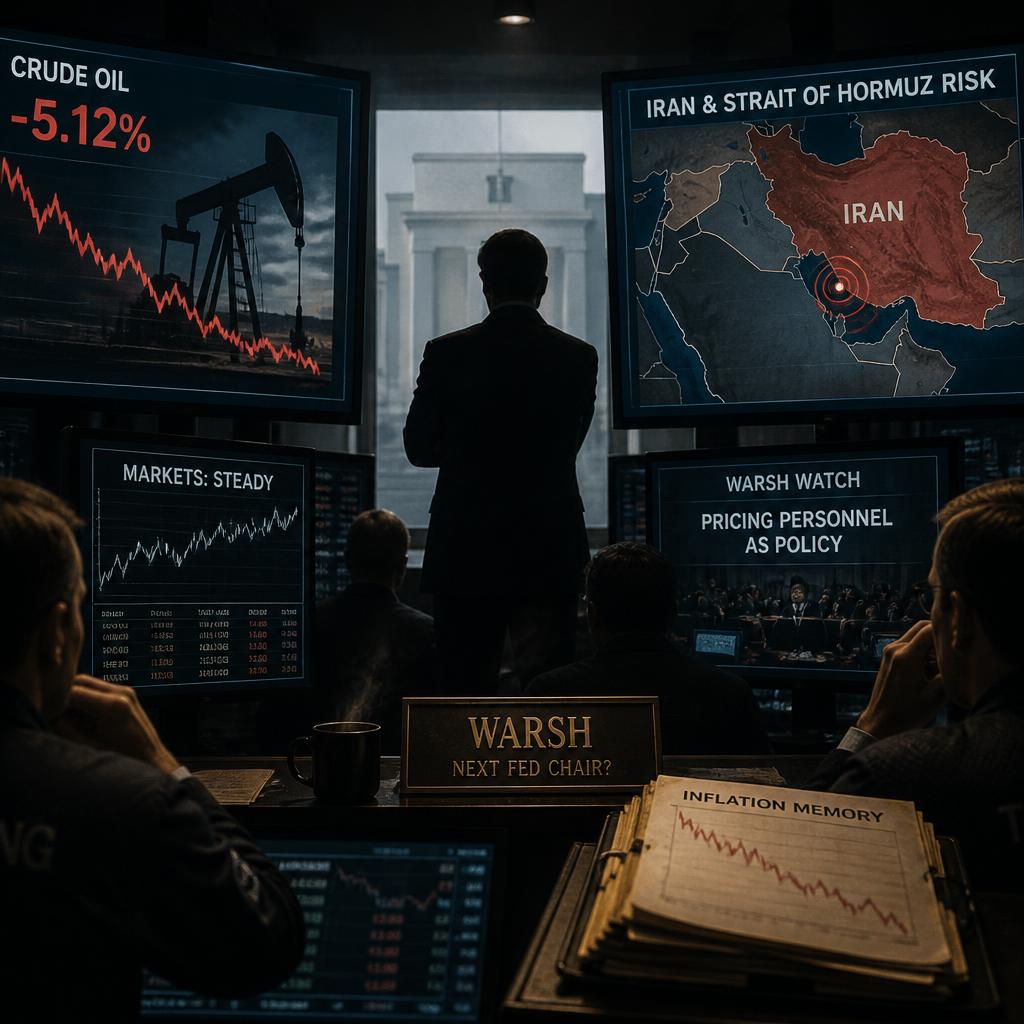
The interesting part is not that markets can be distracted by a name. They have always had a weakness for faces, initials, biographies, whispered appointments, the small court politics of large institutions. The interesting part is that the name can now behave like a policy instrument before the policy has been written. Traders waiting on Kevin Warsh are not merely indulging Washington gossip. They are trying to price a possible future reaction function.
That makes the current market posture stranger than it first appears. Reuters frames the morning as oil extending its fall, stocks holding steady, and investors watching Warsh while also digesting Iran-war diplomacy and lingering uncertainty around the Strait of Hormuz. Those are not separate tabs on a trader’s screen. They are the same question asked in different units: what will inflation risk look like, and who will be trusted to answer it?
A falling oil price can give markets permission to breathe. It softens the most visible channel through which conflict becomes household pain and central-bank difficulty. But Hormuz risk is the sort of risk that never quite disappears when the price dips. It moves from the front page into the option premium, from the barrel into insurance, routing, inventory behavior, and the collective memory of supply shocks. Relief, in this setting, is not the opposite of danger. It is danger discounted for the hour.
The personnel question lands inside that discounting machine. If traders believe a future central banker would be more hawkish, more rules-minded, more tolerant of market pain, or simply more credible against inflation, asset prices can begin adjusting before any nomination, confirmation, speech, or vote. That adjustment may be rational. It may also be circular. Markets price a reputation, then treat their own price action as evidence that the reputation matters.
This is the soft constitutional layer of monetary policy: the institution has formal powers, but the market trades the imagined temperament of the person who may inherit them. After the inflation surge of the early 2020s, credibility is not a decorative word. It is a balance-sheet variable. The chair’s identity becomes shorthand for how fast the central bank might cut, how stubbornly it might hold, how much geopolitical energy noise it would look through, and how much damage it would accept to prove a point.
There is a danger in overstating this. No central banker acts alone, no rumor is a rate decision, and no appointment can repeal the data. Oil can reverse. Iran diplomacy can fail or hold in some partial, unsatisfying way. Congress, the White House, the board, the regional banks, and the yield curve all impose their own weather. Still, the market’s attention is evidence of something real: traders no longer wait only for central-bank action. They front-run the imagined institutional soul.
So the Warsh watch is not finally about Warsh, or at least not only about him. It is about a market that has learned to translate people into duration, oil into inflation memory, and diplomatic uncertainty into central-bank probabilities. Names have become option contracts on future discipline. That may be efficient forecasting. It may be superstition with a Bloomberg terminal. Most days, inconveniently, it is both.
How did this story land?
This may be changed as you like.