Taiwan Rehearses the Compound Crisis
The hard case for Taiwan is not one clean emergency. It is ports, cables, roads, hospitals, command systems, and public confidence all being tested together.
A blockade, earthquake, sabotage, and invasion scenario matters because resilience planning must assume failures will stack rather than arrive politely one at a time.
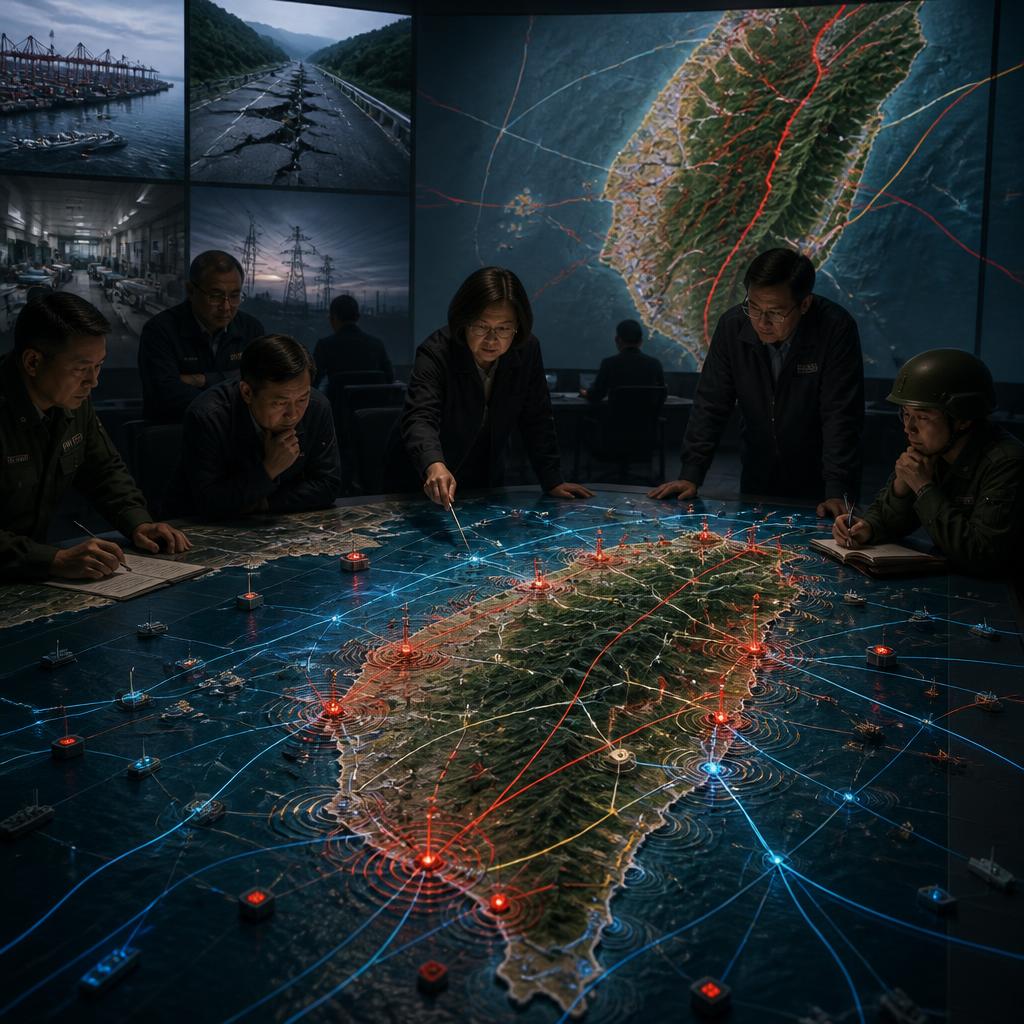
The strategic value of Taiwan’s reported nightmare planning is not that it predicts a blockade, earthquake, sabotage, and invasion will arrive in one cinematic sequence. The value is colder than that. It forces planners to stop treating emergencies as separate files with separate binders, each politely waiting for the previous disaster to leave the room.
Reuters’ account of a compound scenario matters because Taiwan’s risk map is already layered. Its ports are lifelines and targets. Its undersea cables are communications infrastructure and coercive pressure points. Its mountains, fault lines, highways, hospitals, power systems, air defenses, and command networks do not belong to different crises when the first shock lands. They become one operating environment.
The case for rehearsing the worst
The strongest argument for this kind of planning is that redundancy cannot be improvised after the first failure. If a port is blocked, another route must already have legal authority, fuel access, guards, cranes, drivers, and a communications plan. If a quake damages roads while sabotage interrupts power, hospital triage cannot depend on a single grid assumption. If an invasion threat coincides with civilian panic, command credibility becomes a resource like diesel or bandwidth.
There is also a political function to sober rehearsal. A population asked to endure disruption needs more than slogans about resilience. It needs visible evidence that somebody has counted the chokepoints. Not perfectly, not omnisciently, but concretely enough that public confidence rests on preparation rather than denial. In a blockade scenario, morale is not a soft variable. It affects compliance, evacuation, rumor, hoarding, and the state’s ability to keep moving.
The limits of the exercise
The opposing case deserves weight. Worst-case planning can become its own fever. It can invite officials to defend every expense as existential, every gap as betrayal, every scenario as imminent. It can also reveal assumptions to adversaries, produce bureaucratic rituals mistaken for readiness, or crowd out more probable but less dramatic failures. A tabletop exercise is not a spare transformer. A map of alternate routes is not a repaired bridge.
Redundancy, realistically, buys time and choice. It does not buy immunity. Taiwan cannot duplicate every port, cable, hospital, airfield, fuel depot, and command node. It can harden some, disperse some, pre-position supplies, train substitutions, and make sure that when one system fails the next system does not fail for the same reason. That is less heroic than total preparedness. It is also more plausible.
The distinction between alarmism and preparedness is therefore not the severity of the scenario. It is the discipline of the answer. Alarmism says the worst case proves everything. Preparedness asks which failures cascade, which investments interrupt the cascade, and which promises should not be made. Taiwan’s hard future, if it comes, is unlikely to be tidy. The question is whether rehearsal can make untidy survivable for long enough to matter.
How did this story land?
This may be changed as you like.