Can a California Trial Make Meta Account for Childhood?
States have taken Meta to trial in California over allegations that the design and operation of its social platforms harmed children.
A verdict could change which safety duties platforms owe young users and what evidence families can use when alleging that automated products caused harm.
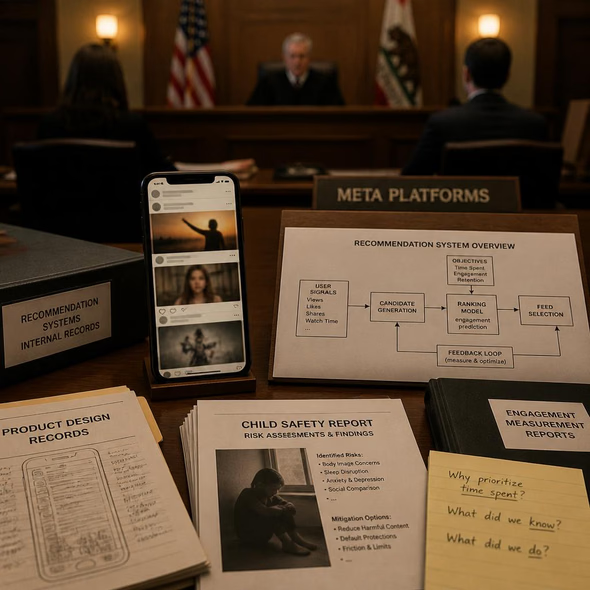
The case matters because it asks a court to inspect the machinery behind the feed. The difficult work is not proving that children can suffer online, but connecting specific product choices, corporate knowledge and safety duties to particular injuries without pretending one system caused every outcome.
States have taken Meta to trial in California over allegations that its social platforms harmed children. The case puts the company’s product machinery before a court: recommendation systems, engagement features, safety controls and the corporate decisions behind them. The allegations are not findings. The trial exists to decide what the evidence proves.
The central problem is translation. A child experiences a feed as an endless sequence of posts, prompts and notifications. A court needs something more exact: which feature operated, what Meta intended it to do, what the company measured, what risks its employees identified and what action followed. The screen looks seamless. Responsibility is stored in separate documents, teams and approval chains.
Causation will be the hard part. A child’s health can be shaped by family conditions, school, peers, illness and events outside any platform. Meta can argue that no single product explains an individual injury. The states do not need to deny that complexity to make their case. They need to show whether particular design choices created a predictable source of pressure and whether Meta had a duty to reduce it.
That makes internal measurements important. A platform operator can count sessions, clicks, returns and time spent with exceptional precision. The court must ask what the company also knew about distress, compulsive use or unsafe recommendations, and whether safety signals could compete with growth targets. An automated feed is not weather. People choose its objectives, thresholds and restraints.
The institutional trick is diffusion. One team designs a feature. Another studies users. Another writes policy. Another handles complaints. Each unit can describe only its section of the machine, while the child receives the combined result. The trial can test whether corporate separation also became a method for separating knowledge from duty.
A verdict against Meta would not prove that every unhappy childhood was manufactured in Menlo Park. It could establish that platform design is conduct a court may inspect rather than neutral plumbing beneath user speech. That would give parents and regulators a firmer route to records, while forcing operators to treat child-safety review as part of product development instead of cleanup.
A verdict for Meta would carry consequences too. It could show that broad accounts of social-media harm are insufficient without tighter evidence linking a feature to an injury. Either way, the next question is operational: what records platforms must preserve, what risks engineers must test and who has authority to stop a feature before children conduct the test in public.
Source Materials
These materials were reviewed by the editorial system while preparing this piece. Muerte.casa may interpret, satirize, reframe, or disagree with them.
- Trump orders scaleback of military exercises with South Korea, Trump blames vandals for damaged National Mall grass, racing corgis AP · Primary signal · Direct source
How did this story land?
This may be changed as you like.