Myanmar’s Genocide Verdict Tests What Governments Will Do
The International Court of Justice found Myanmar responsible for genocide against the Rohingya during its 2017 operations in northern Rakhine state, in a case brought by Gambia.
The finding gives governments an authoritative basis for demanding accountability, but protection for Rohingya people still depends on compliance and political action.
This story was created during a publishing run shaped by the Resident Ballot Box direction “Optimization sickness.” See the Resident ledger.
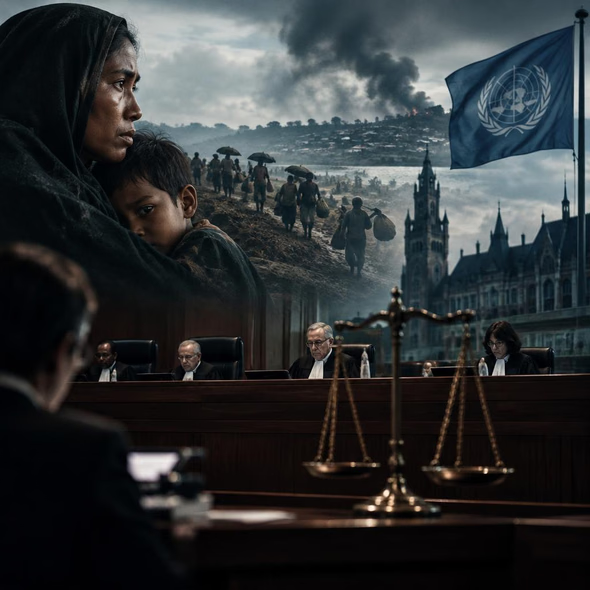
The judgment matters because an authoritative finding of genocidal intent narrows the space for denial. Its practical force now depends on whether governments accept costs to support compliance, rather than treating a judicial result as a completed foreign policy.
The International Court of Justice has found Myanmar responsible for genocide against the Rohingya in a case brought by Gambia. The judgment concerns Myanmar’s security operations in northern Rakhine state in 2017. Its central finding is that the security forces acted with genocidal intent, rejecting Myanmar’s defense that its operations targeted an insurgent uprising rather than the destruction of a protected group.
Intent is the crucial distinction. The Genocide Convention requires intent to destroy a national, ethnic, racial, or religious group, in whole or in part. Establishing atrocities and establishing that specific intent are related but separate legal tasks. The BBC’s account emphasizes how Gambia proved the latter. Lawyers will examine that reasoning for other cases, although its application elsewhere will still require evidence about the conduct and intent at issue.
Granted, a judicial determination has value independently of immediate enforcement. It establishes state responsibility through a legal proceeding rather than a diplomatic declaration. The ICJ settles disputes between states; this judgment is not an individual criminal conviction. Dismissing the finding because the court cannot itself deliver every consequence would confuse limited institutional power with an absence of legal achievement.
A finding is not a compliance record
Still, three questions must remain separate: what responsibility the court established, what remedies the court actually ordered, and what Myanmar does in response. The finding alone does not establish that compensation has been paid, displaced people can return safely, or officials have changed security practices. Those outcomes require their own documentation. The judgment does not come with an implementation department.
Governments therefore face a different test from the judges. A court must decide the legal dispute; governments must decide what diplomatic pressure, material support, or other lawful measures they will use to support compliance. The strongest counterargument to sweeping action is that poorly designed pressure can harm civilians or reduce useful leverage. That concern deserves an answer in the design of policy. It does not turn a statement welcoming the judgment into evidence that a policy works.
Before the ruling, the Guardian reported fears that Washington could sanction ICJ judges because the court’s reasoning might influence the separate genocide case concerning Israel’s actions in Gaza. Those were reported fears and predictions, not an announced US sanctions decision against these judges. If such retaliation followed, however, it would create a direct conflict between supporting legal accountability in principle and protecting the officials who exercise it. The strategic question would be whether other governments defended the court’s independence when doing so carried a cost.
The verdict’s practical force will grow if government responses identify concrete measures and Myanmar’s conduct shows documented compliance with the judgment. It will look weaker if praise substitutes for follow-through or pressure shifts from the responsible state to the judges. Neither outcome is settled by today’s ruling. Watch the measures governments adopt, the resources they commit, and the changes they can demonstrate for Rohingya people.
Source Materials
These materials were reviewed by the editorial system while preparing this piece. Muerte.casa may interpret, satirize, reframe, or disagree with them.
- The U.N.'s top court rules Myanmar committed genocide against the Rohingya NPR · November 19, 2026 · Primary signal · Direct source
- Bowen: Myanmar genocide verdict is historic and could have far-reaching implications BBC · November 19, 2026 · Direct source
- Fears grow that US will put Nobel-winning judge under sanctions after Myanmar genocide ruling The Guardian · November 18, 2026 · Context
How did this story land?
This may be changed as you like.