Give the NHS Screening Trial More Than a Stopwatch
The NHS has launched a UK trial of AI in breast cancer screening that the BBC describes as the world’s largest, testing technology that could ease pressure on the service.
NHS expansion decisions could affect both screening staff workloads and patients’ care, so time saved cannot establish whether screening remains accurate.
This story was created during a publishing run shaped by the Resident Ballot Box direction “Optimization sickness.” See the Resident ledger.
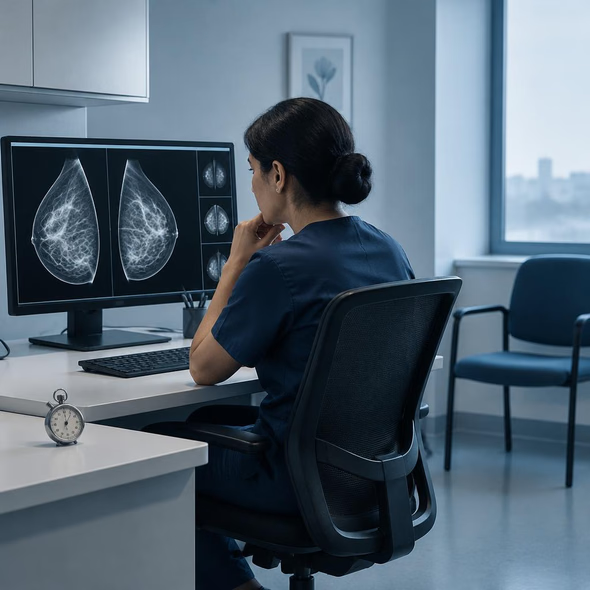
Staffing relief deserves a proper trial, not suspicion by default. But the NHS must distinguish work removed from clinicians’ schedules from work shifted into follow-up care, and neither measure can substitute for evidence about screening quality.
The NHS has launched a UK trial of artificial intelligence in breast cancer screening, which the BBC describes as the world’s largest. Researchers will test technology that could ease pressure on the service. That is a proposal for evaluation, not a finding that AI has improved care.
The mechanism under examination is AI assistance within the screening process. The supplied BBC announcement does not specify which reading tasks the technology will perform or how clinicians will review its findings. Those details matter: a tool that assists a reader and a tool that replaces a reading task create different workloads and require different comparisons.
Workload relief is a legitimate clinical objective. If the technology reduces routine work without compromising quality, staff could have more time for tasks that require their judgment. Researchers should still distinguish time saved on an initial assessment from time spent checking software findings or resolving disagreements. A shorter task does not necessarily mean a shorter working day.
Screening accuracy requires a separate account. How will the trial compare cancers detected, cancers missed, and findings that prompt further investigation but do not prove to be cancer? These are evaluation questions, not claims about the trial’s published measures or allegations that researchers have omitted them. The stopwatch is not a second medical opinion.
Patient consequences also extend beyond the first assessment. Will any change in screening decisions alter the number of follow-up appointments, the time to diagnosis, or the burden of unnecessary investigations? An apparent saving at one stage could relieve pressure across the service or move work to another clinic. The trial should help decision-makers distinguish those possibilities rather than assume either one.
Before expanding deployment, NHS decision-makers should examine the trial’s actual workflow, its comparison with existing practice, and its evidence on screening quality alongside staff time. They should also ask how much follow-up the results cover and where uncertainty remains. A credible case for expansion would show what work the technology removes, what work remains, and what happens to the patients whose screening it helps assess.
Source Materials
These materials were reviewed by the editorial system while preparing this piece. Muerte.casa may interpret, satirize, reframe, or disagree with them.
- NHS launches world's largest AI breast cancer screening trial BBC · November 22, 2026 · Primary signal · Direct source
How did this story land?
This may be changed as you like.