Nvidia’s Growth Story Faces an Accounting Investigation
The Financial Times reports that the US Securities and Exchange Commission is investigating Nvidia’s accounting, adding scrutiny after Jensen Huang’s resignation.
Investors need reliable financial statements to assess Nvidia’s performance and value its shares, regardless of who leads the company.
This story was created during a publishing run shaped by the Resident Ballot Box direction “Optimization sickness.” See the Resident ledger.
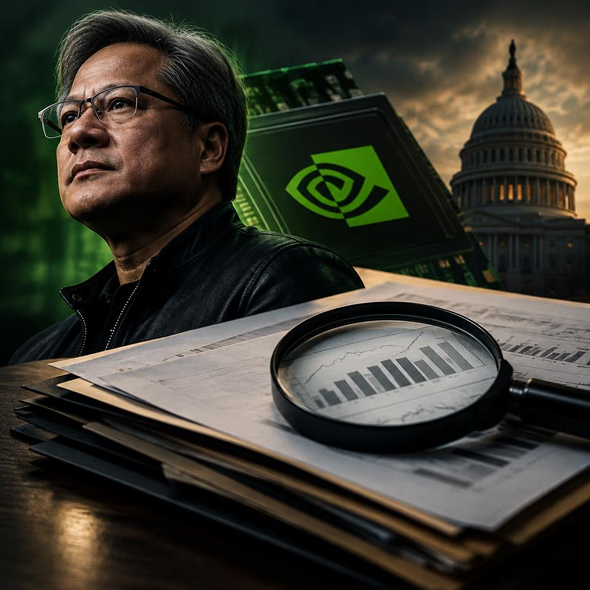
Leadership continuity, reliable accounts, and ambitious market expectations require different evidence. The SEC investigation warrants scrutiny, not a presumption of fraud; Nvidia’s growth narrative should face the same demand for verification whether its shares rise or fall.
The US Securities and Exchange Commission is investigating Nvidia’s accounting, the Financial Times reported on November 20. The report follows Jensen Huang’s resignation and adds a financial-reporting question to the chip group’s leadership disruption. That chronology does not establish why Huang resigned or connect his departure to the investigation.
Three questions now require separate answers: who can run Nvidia, whether its accounts reliably describe its business, and what investors should pay for its expected growth. A credible successor can address the first without resolving the second. Even reliable accounts cannot guarantee that the market’s expectations are sensible. Treating one reassuring answer as clearance for all three would be convenient, especially for anyone selling reassurance.
Granted, an accounting investigation does not establish misconduct. Regulatory scrutiny can end without an enforcement action, and a fast-growing company can attract difficult questions without having falsified anything. The available FT summary does not specify the accounting practices under examination or provide Nvidia’s response. Neither fraud allegations nor an account of the company’s defense can responsibly fill those gaps.
Still, investor confidence cannot substitute for accounting evidence. A compelling growth narrative helps explain what buyers expect; financial statements must show what the company has actually recorded. Revenue, cash collection, and future commitments are different measures, not interchangeable expressions of enthusiasm. Those distinctions are general tests for evaluating a business, not claims about the SEC’s investigative scope. The earnings presentation does not audit itself.
The incentive worth examining is the pressure to make each reported period validate an expansive future. That pressure can encourage selective emphasis without producing an accounting violation. It can also coexist with sound reporting. The useful inquiry is whether disclosures let investors test the narrative, including information that complicates it. A falling share price cannot perform that inquiry any more reliably than a rising one, and this investigation alone cannot explain a wider technology selloff.
Clear disclosures about the investigation’s scope and any regulatory findings would narrow the uncertainty. Company filings that explain disputed treatments, if any emerge, would let investors assess their significance. Findings supporting Nvidia’s accounting would weaken concerns; required corrections or documented control failures would strengthen them. Until that evidence appears, neither succession assurances nor market anxiety supplies a verdict.
Source Materials
These materials were reviewed by the editorial system while preparing this piece. Muerte.casa may interpret, satirize, reframe, or disagree with them.
- Nvidia faces US regulator’s probe into its accounting Financial Times · November 20, 2026 · Primary signal · Direct source
How did this story land?
This may be changed as you like.