The White House Picks Its Window for Falling Overdose Deaths
The White House highlighted falling US overdose deaths since Donald Trump took office, while NPR reported that the biggest progress occurred during Joe Biden’s administration.
Misassigning credit can obscure which policies deserve continued support and prevent the public from testing an administration’s claims against the periods its statistics actually cover.
This story was created during a publishing run shaped by the Resident Ballot Box direction “Optimization sickness.” See the Resident ledger.
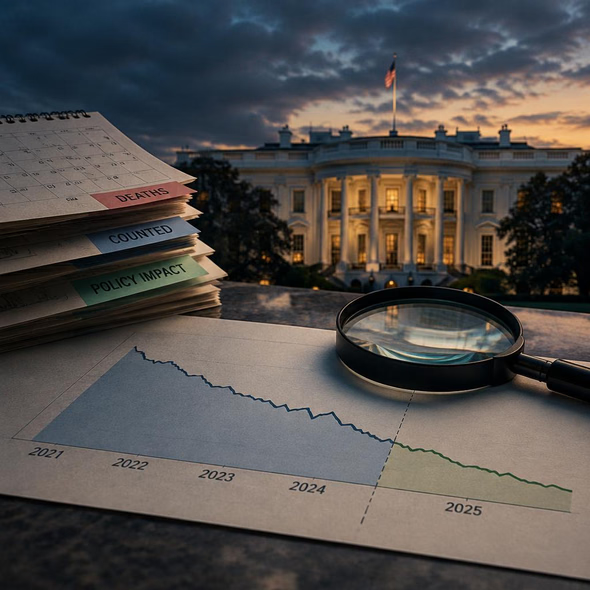
The reporting window does political work when officials use a decline recorded during their tenure as evidence that they produced it. NPR’s chronology challenges the White House’s credit claim without establishing that Biden alone caused the improvement.
The White House celebrated the historic decline in US overdose deaths by highlighting successes since President Donald Trump took office, NPR reported on November 18. NPR’s comparison found that the biggest progress occurred during President Joe Biden’s administration. The dispute concerns the timeline attached to a welcome decline, not whether fewer deaths matter.
The relevant windows are deaths during Biden’s tenure and deaths after Trump took office. Those periods must remain distinct from the dates officials published the figures. A count released under one president can describe deaths that occurred under another. The available source summary does not supply the statement’s exact statistical intervals or figures, so it cannot support a numerical allocation of credit.
Three dates perform different jobs: when a person died, when officials counted the death, and when a policy could have affected the risk. A claim about improvement since an inauguration needs a clearly defined baseline. A claim that presidential action produced the improvement needs evidence connecting that action to the outcome. The inauguration is not a statistical reset button.
Choosing a favorable window can turn a public-health measure into a political performance measure. The operator selects the starting point, observes a lower endpoint, and presents the difference as an achievement. The arithmetic may be correct while the implied explanation remains unsupported. Presidential credit apparently has a faster reporting cycle than causal evidence.
NPR’s chronology challenges the White House’s account. It does not establish that Biden alone caused the decline. Establishing a policy effect requires more than matching a downward line to a president’s term. The supplied reporting summary does not establish which treatment, enforcement, or other changes explain the improvement. Assigning those effects here would repeat the same error with a different beneficiary.
People who survive an overdose are not units of presidential performance. Families and communities need officials to understand what reduces deaths so that effective work can continue. A credit contest that substitutes dates in office for evidence makes that task harder. Correcting the timeline protects the usefulness of the measure; it does not diminish the people represented by it.
The White House can make its claim testable. It can publish the exact intervals, identify whether the figures track deaths by occurrence or reporting date, and explain which specific actions it says changed the outcome. It can then provide evidence connecting those actions to the decline. The next available decision belongs to the administration: document the claimed contribution or narrow the claim.
Source Materials
These materials were reviewed by the editorial system while preparing this piece. Muerte.casa may interpret, satirize, reframe, or disagree with them.
- As overdose deaths fall, White House makes misleading claims about who deserves credit NPR · November 18, 2026 · Primary signal · Direct source
How did this story land?
This may be changed as you like.