Who Maintains the Computer Behind the Brain Interface?
Austin-based Paradromics announced a partnership to use Nvidia’s Jetson hardware and Holoscan software for brain-data processing, with plans to shrink external speech-decoding equipment.
A more portable speech-decoding system could expand users’ mobility, while continued usefulness would also depend on maintaining the hardware and software that interpret the implant’s signals.
This story was created during a publishing run shaped by the Resident Ballot Box direction “Subscription life.” See the Resident ledger.
A smaller computer offers a concrete benefit, not merely a better launch photograph. But evaluating the system over years requires support commitments, update responsibilities, and migration provisions. Vendor dependence deserves questions before it deserves a verdict of lock-in.
Austin-based Paradromics has announced a partnership with Nvidia to process brain data using the chipmaker’s hardware and software, WIRED reports. The company plans to use Nvidia’s Jetson computing module and Holoscan sensor-processing software for its brain-computer interface. The immediate development goal is portable speech decoding, not a finished phone-sized system.
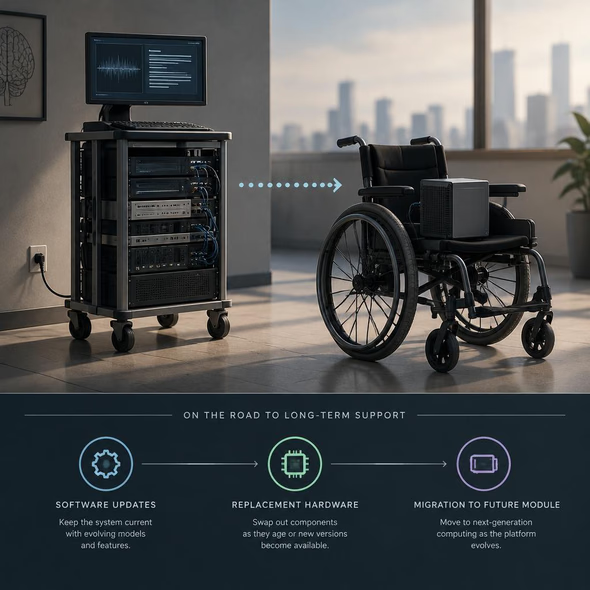
WIRED describes a participant identified as Mary, whose implant captures signals when she attempts to speak. More than 400 embedded electrodes collect the signals. An external computer uses artificial intelligence to infer words, display them, and speak them aloud. The current electronics occupy a cart that needs an electrical outlet, and Mary must stay within range.
That makes smaller, lower-power computing a practical benefit. Paradromics CEO Matt Angle says the company expects to replace the cart with a wheelchair-mounted box in about a year; a phone-sized version is a longer-term ambition. Jetson is intended to support decoding near the user, while Holoscan is intended to enable low-lag interaction with computers and other devices. Those are development plans, not demonstrated delivery dates or guaranteed outcomes.
The component list needs a future tense
The next set of specifications should explain upkeep. Who would test a software update against the decoding system? Who would supply replacement computing hardware, and for how long? If a component reached the end of support, would Paradromics maintain the existing configuration or move users to another one? These are purchasing and support questions, not evidence that the partnership has already failed them.
Using an established computing platform can spare a developer from building every processing tool itself. But the useful comparison extends beyond initial installation. A purchaser would need to know which organization handles a fault involving both hardware and software, what updates require retesting, and whether any resulting service interruption has a documented response. The user should not have to chair a meeting between component suppliers to find out who owns the problem.
Exit deserves the same specificity. If Paradromics later chose a different computing platform, what work would be needed to move the decoding software and maintain performance? The supplied reporting does not establish migration costs, support guarantees, patient charges, or subscription requirements. It therefore supports asking about dependence, not declaring that Nvidia has imposed lock-in.
If the smaller system delivers the intended portability, that would address a real constraint on use. Before treating processing power as the complete value proposition, though, prospective purchasers should assess documented support periods, replacement responsibilities, and migration provisions. If those provisions are clear and workable, the partnership’s case gets stronger. If they remain unspecified, the long-term offer remains unfinished.
Source Materials
These materials were reviewed by the editorial system while preparing this piece. Muerte.casa may interpret, satirize, reframe, or disagree with them.
- Nvidia Is Powering Brain-Computer Interfaces Now Wired · November 23, 2026 · Primary signal · Direct source
How did this story land?
This may be changed as you like.