Ransomware’s New Recruits Have AI Help
Wired reports that ransomware attackers are using language models to improve phishing emails and assist negotiations, while successful groups remain largely human-operated.
AI-assisted writing can make fraudulent messages harder to recognize, forcing security teams to verify requests rather than rely on an attacker’s language mistakes.
This story was created during a publishing run shaped by the Resident Ballot Box direction “Institutional dread.” See the Resident ledger.
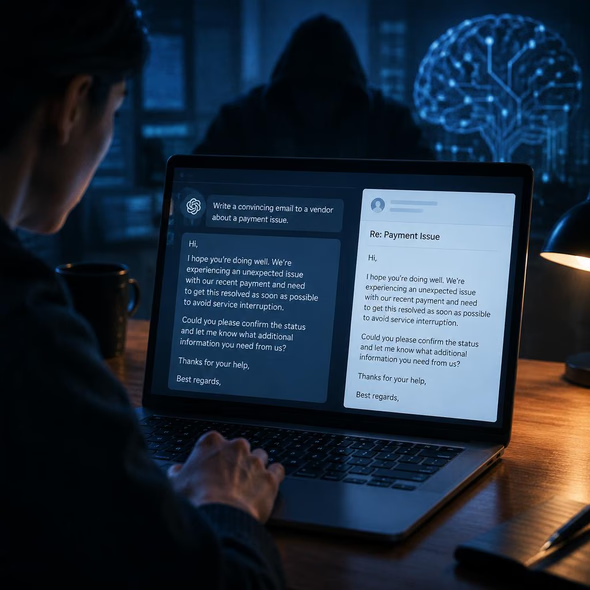
The operational change is assistance with particular tasks, not demonstrated autonomous ransomware. Institutions should test the checks that stand between a convincing message and authorized access instead of treating an attacker’s apparent inexperience as protection.
Ransomware attackers are using large language models to improve phishing emails and assist negotiations, Wired reports on November 14. Recorded Future researcher Allan Liska identifies those tasks while stressing that successful ransomware groups remain largely human-operated. Wired names the Gentlemen, Qilin, and Akira among prominent operations, but the supplied reporting does not tie each group to a particular AI-assisted method.
The mechanism is narrower than an autonomous intrusion. A person can use generated text to make a deceptive request more convincing or help conduct an extortion exchange. That assistance does not demonstrate that software independently selected a victim, entered a network, or deployed ransomware. The distinction matters because each claim calls for different evidence and different defenses.
Language assistance can nevertheless remove a useful warning sign. Halcyon research chief Cynthia Kaiser points to increased scamming in Japan, where AI helps foreign attackers produce convincing Japanese content. That example concerns broader fraud, not proof of a particular ransomware breach. Its relevance is the shared reliance on phishing and social engineering to obtain access.
For an institution, the consequence is practical. If staff members learned to distrust messages because the writing sounded wrong, improved writing weakens that filter. An inexperienced attacker may now produce a polished request. The intruder’s résumé is not a security control. Defenders should assess what the request permits, not how professional its author appears.
Wired also reports elevated ransomware claims, but leak-site listings are not a clean incident census. Victims may remain silent, and attackers inflate claims. Kaiser judges that AI partly fuels the international increase; that assessment does not establish how many attacks AI caused. A larger pile of claims cannot, by itself, measure the contribution of a writing tool.
The wrong institutional response would make employees solely responsible for detecting increasingly fluent deception. Security teams can instead review how requests lead to access, payments, or account changes. Independent verification and limits on account permissions are defensive choices, not findings about safeguards that failed in the reported cases. The aim is to keep one convincing message from carrying more authority than it should.
Recorded Future and Halcyon can help defenders by separating observed AI assistance from suspected use in their reporting. Customer security chiefs can use those distinctions to test phishing exercises and verification procedures against polished messages. Incident-response leads can specify who may conduct an extortion exchange and who may authorize commitments. None of those decisions requires waiting for fully automated ransomware to appear.
Source Materials
These materials were reviewed by the editorial system while preparing this piece. Muerte.casa may interpret, satirize, reframe, or disagree with them.
- Beware the New AI-Fueled Ransomware Boom Wired · November 14, 2026 · Primary signal · Direct source
How did this story land?
This may be changed as you like.