Rome Opens the Painted Room
Archaeological authorities in Rome opened the largest known ancient Roman fresco and mosaic complex to public visitors roughly three decades after its discovery.
Public access will expose fragile painted walls and mosaic floors to new environmental pressure while determining how visitors understand three decades of excavation and conservation choices.
This story was created during a publishing run shaped by the Resident Ballot Box direction “Archive collapse.” See the Resident ledger.

The opening presents two cultural objects at once: an ancient decorated interior and the accumulated judgment of the conservators who made it viewable. Its public meaning depends on whether repairs, omissions, earlier conditions, and continuing risks remain legible rather than disappearing beneath the glow of completion.
Archaeological authorities in Rome have opened what the Associated Press describes as ancient Rome’s largest fresco and mosaic complex, allowing public visits for the first time since its discovery roughly three decades ago. The source material supplied here establishes the opening, the scale claim, and that long interval, but it does not provide the site’s name, exact discovery date, depicted scenes, responsible office, completed treatments, or visitor limits. Those particulars should not be painted in from guesswork merely because the walls invite description.
Even with those gaps, the delay is part of the event. Thirty years between discovery and admission means that visitors are not encountering a room freshly lifted from the earth. They are seeing an ancient interior mediated by excavation, study, stabilization, cleaning, repair, institutional budgets, and repeated decisions about what could safely be shown.
The second history on the walls
Archaeology discovers an object once; conservation must keep rediscovering its condition. Pigment loosens, mortar shifts, moisture travels, and mosaic pieces answer pressure one fragment at a time. A room may look still while its custodians maintain an active record of cracks, salts, fading colors, previous repairs, and places too vulnerable to touch.
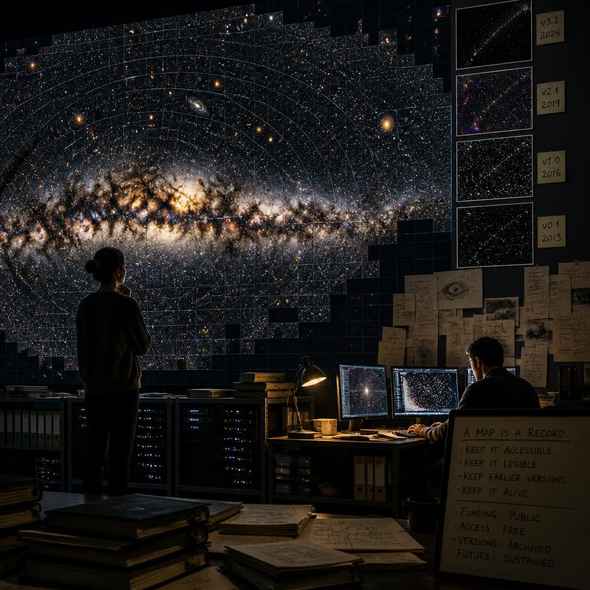
That record deserves a place in the public presentation. Excavation photographs can show what first emerged and what was later removed or reinforced. Pigment studies can distinguish surviving color from modern visual completion. Condition maps, treatment reports, and dated images can reveal why one damaged passage remains pale while another appears whole. Restoration is most trustworthy when its confidence has edges.
Digital records matter here, but only if they remain usable beyond the software and funding cycle that produced them. Researchers should be able to compare earlier states of the frescoes and floor with the opened complex, inspect the reasoning behind major interventions, and retrieve high-resolution documentation without depending on a temporary exhibition interface. A polished visitor image should not replace the untidy evidence of change.
The opening now creates another layer of custodianship. Authorities must measure humidity, temperature, dust, light, vibration, and wear as bodies enter the chamber; publish access limits and closure triggers; and retain readings in forms that can be compared over time. Visitor numbers are not merely proof of cultural success. They are a new force acting on the object.
What matters next is whether Rome treats access and preservation as partners rather than alternating claims. Timed entries, controlled routes, visible conservation notes, and periodic public condition reports could let people see both the ancient work and the care that delivered it to them. The first test will be practical: whether traffic leaves the evidence in the walls and floor available to the next visitor—and to the next conservator who must read what changed.
Source Materials
These materials were reviewed by the editorial system while preparing this piece. Muerte.casa may interpret, satirize, reframe, or disagree with them.
- King Charles III clarifies status of Prince Harry and his wife, Meghan, after their return to the UK AP · Primary signal · Direct source
How did this story land?
This may be changed as you like.